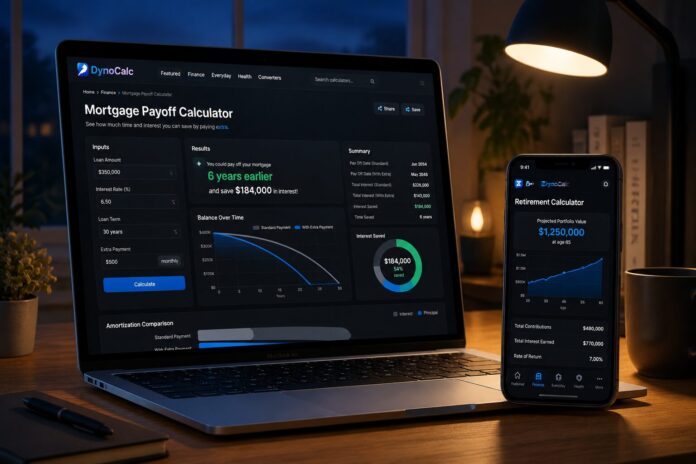
I did not start DynoCalc as a single idea or a planned product. It came together slowly over years, almost accidentally, through a long chain of small tools I kept building whenever I needed to solve something in my own life. Some of them were Excel spreadsheets with messy formulas I would reuse over and over. Some were simple web pages I spun up just to run a calculation without opening a full app. Some were lightweight tools I built quickly just to get an answer and move on.
Each one existed because I needed it in that moment. Not because I was trying to build a platform, but because something in my real life required clarity and I did not want to rely on whatever was already out there. It might have been tracking something financial, comparing options, converting measurements, or just testing a scenario I could not easily reason through in my head. The tool always came second. The problem always came first.
Over time, I started noticing a pattern in how often I was rebuilding the same kinds of solutions. I would solve something in Excel, then later rebuild a cleaner version as a web page, then sometimes rebuild it again as a lightweight app just because I wanted it faster or easier to access on my iPhone. It was never intentional product thinking, it was just repetition driven by necessity.
Eventually I reached a point where I realized I was not just making random tools anymore. I was repeatedly solving the same category of problem in slightly different ways, and each version was teaching me something about how people actually think when they are trying to make sense of numbers in real life.
That is when DynoCalc started to form, not as a single project, but as a collection of everything I had already built for myself over time.
Built From Necessity, Not Strategy
Most of the early tools came from very practical needs. Sometimes it was financial planning where I needed to quickly model different outcomes without relying on a heavy spreadsheet every time. Sometimes it was conversions or timing problems where I just wanted a fast answer without digging through multiple sites or apps. Sometimes it was about trying to lose a little weight and make sure I was on the right trajectory. Sometimes it was just curiosity where I wanted to see how changing one variable affected another in a controlled way.
The common thread was always the same. I needed clarity quickly, and whatever existed at the time either felt too heavy, too slow, or too cluttered for what I was trying to do. So I would build something small and direct that solved that exact problem and nothing more.
In hindsight, it was not really separate tools. It was the same mindset repeated in different forms, shaped by whatever situation I was in at the time.
From Spreadsheets to Web Pages to Small Apps
A lot of it started in Excel because that was the fastest way to model logic. I could throw together formulas, test outcomes, and refine them until they made sense. But spreadsheets are not always the most comfortable interface for real time thinking, so eventually I would rebuild those same ideas as simple web pages where I could interact with them more naturally.
Then came lightweight apps for things I used often enough that I wanted them to feel immediate. Nothing complex, just clean interfaces over the same logic I had already tested in spreadsheets. Each version was less about improving the idea and more about removing friction from how I used it.
That progression happened many times over the years without me really thinking about it as a system. It was just me solving the same types of problems in better ways as my tools improved.
There Was Something Bigger Here
The turning point for this project was not a single moment of inspiration. It was more gradual, like noticing a pattern that had been there the whole time. I realized I was not just building isolated tools anymore, I was repeatedly creating small systems for understanding real life decisions.
Money, timing, health metrics, conversions, planning scenarios, all of it started to feel like variations of the same underlying need. I was always trying to reduce uncertainty by breaking a situation into something I could test and understand before committing to it.
That is when I started to think there might actually be something here beyond personal use. Not just a collection of tools for myself, but something structured enough that other people could benefit from it too.
DynoCalc Was Born
Once I stepped back and looked at everything I had built over the years, it became clear that it was not random. It was a system of thinking tools that had evolved through necessity. I was not trying to build a product from scratch, I was assembling something that already existed in pieces.
DynoCalc became the way to unify all of that into one place. A single experience that combines financial thinking, health calculations, conversions, and everyday decision tools into something that reflects how people actually live, which is not in categories but in moments where they need clarity fast.
It is not about replacing deeper tools or complex systems. It is about handling the small and medium decisions that happen constantly and quietly shape how people move through their day.
Then $370,000 Changed Everything
The real turning point was not technical at all. It was personal. I ran into a number that completely shifted how I looked at everything I was building.
$370,000 for four years of college.
That number did not land like a statistic. It landed like a ton of bricks. It is one of those numbers that does not fully make sense until you sit with it long enough to understand what it actually means in real life terms. It is not abstract anymore when it is tied to your family, your future, and the decisions you are trying to make as a parent.
My daughter is an amazing person who deserves the chance to pursue her strengths and build her future without carrying the weight of that kind of cost before she even starts. That is what made it hit differently. It stopped being a general conversation about education costs and became something much more immediate and real.
That is when DynoCalc stopped being just something I was building out of habit and started becoming something I was actively using to think through reality itself.
What is DynoCalc Really?
At its core, DynoCalc is a reflection of all those years of small tools built out of necessity. It is not one idea, it is a collection of problems I kept solving in different ways until it became clear they all belonged together.
It is meant to give people a place to think clearly, test scenarios quickly, and understand the shape of decisions before they make them. Not in an abstract sense, but in the same practical way those early spreadsheets and small tools helped me when I needed answers fast.
DynoCalc offers you a chance to make mistakes in cyberspace with no judgement. Better to make mistakes in a tool than in the real world, right? That is the foundation it was built on, and the reason it exists at all.
Final Thought
DynoCalc did not start as a product idea. It started as necessity repeated over and over in different forms until it became something coherent.
It began with spreadsheets, became web tools, turned into lightweight apps, and eventually became a unified system because I realized I was solving the same kind of problem every time. What changed was not the idea, but the realization that other people might need the same kind of clarity I was building for myself all along.
That is what brought it together.
Support and Why It Matters
DynoCalc is and will always be free to use. That was never something I wanted to compromise on because the whole idea is to make everyday thinking and decision making more accessible, not less.
If you find it useful and it genuinely helps you think through decisions more clearly, the most meaningful thing you can do is simply share it with others who might benefit from it as well. That kind of organic support is what keeps a project like this alive.
For those who want to go a step further, there is also a Patreon available where you can support ongoing development of this project. Any support there goes directly into improving DynoCalc over time, expanding the tools, refining the experience, and keeping it fast, clean, and useful.
Over the next few years, part of that support will also go toward something deeply personal for me, which is helping cover my daughter’s college tuition. That is not the reason DynoCalc exists, but it is part of the reality behind why I am building it the way I am.
Either way, whether you use it, share it, or support it, I genuinely appreciate it. This is something I am building for the long term, and every bit of feedback, use, and support helps shape where it goes next.
It was the evening of August 31, 2023, 8 PM Eastern to be precise. The air was electric with anticipation of the dropping of the most highly anticipated game of 2023 to date. This time it was Bethesda’s very own Starfield. This is a space exploration action RPG that takes place in the early 24th century. The game would release on both Xbox and PC. Wait…did they say PC? Well, then that means it has a chance of running on the Asus ROG Ally. So I plunged in to the deep end with my 5 day early access and set off on my adventure into the cosmos. I live streamed the whole event on SwitchEffect on YouTube.
The excitement on the live chat from my subs were all about the ROG Ally. Will it run Crysis?….err…Starfield. With little to no tweaking, it ran Starfield like a champ at 30 watts, 1080p, 120 Hz, anywhere between 30 and 50 FPS depending on the situation.
This title is a solid one and a great win for Bethesda and Microsoft. Will it earn GOTY? Not if The Legend of Zelda: Tears of the Kingdom has anything to do with it. Who knows. Metacritic rates it an 88. Still has to beat TOTK’s 96 score. But there’s still time, and it’s gaining.
There were a number of follow-ups to complete for my subs on the live chat. Here are the stats I personally tested and gathered on FPS this morning. Not scientific, but good enough to give you guys and gals an idea of what you can expect from the ROG Ally.
Important Notes: I used default settings when Starfield was initially installed on ROG Ally (Preloaded before 8/31, with update on 8/31 at ~8:00 PM (ET). AMD Radeon Software update installed. AMD Software: Adrenalin Edition 23.8.2 Released 8/17/2023. Asus ROG Ally was plugged in the whole time on PD 100 charger to Baseus Dock that supports PD 100. No tweaks were made to Starfield Graphics settings.
Hey Nintendo fans! Guess what? I recently made the ultimate gaming pilgrimage to the iconic Nintendo New York store. Trust me, it’s a gaming paradise right in the heart of the concrete jungle! Let me take you on a virtual tour of this gamer’s wonderland.
As soon as I stepped inside the store, I was greeted by vibrant colors, cheerful music, and an atmosphere buzzing with excitement. It felt like I had entered the Mushroom Kingdom itself! The walls were adorned with larger-than-life characters, and the air was filled with a sense of nostalgia and anticipation.
First things first, I made a beeline for the merchandise section. Oh boy, was I in for a treat! From t-shirts featuring our beloved plumber Mario to adorable plushies of Yoshi and Pikachu, the store had a treasure trove of goodies for every Nintendo fan. I was very tempted to splurge on a Mario-themed cap, a Legend of Zelda keychain, and a Super Smash Bros. poster to decorate my gaming corner at home.
Next up, I had to check out the game section. It was a gamer’s dream come true! Rows and rows of Nintendo Switch games neatly lined the shelves, offering an extensive collection for every taste. From must-have classics like The Legend of Zelda: Breath of the Wild and Super Mario Odyssey to the latest releases like Animal Crossing: New Horizons and Splatoon 3, the store had it all. The sheer variety of titles made it challenging for me to decide which ones to add to my collection!
As I ventured further into the store, I discovered a dedicated area for Nintendo hardware. Nintendo Switch consoles, the OLED, classic and the Lite versions, stood proudly, ready to be taken home by eager gamers. The store had an extensive range of accessories as well, from colorful Joy-Con controllers to protective cases and screen protectors. It was a one-stop shop for all your Nintendo gaming needs!
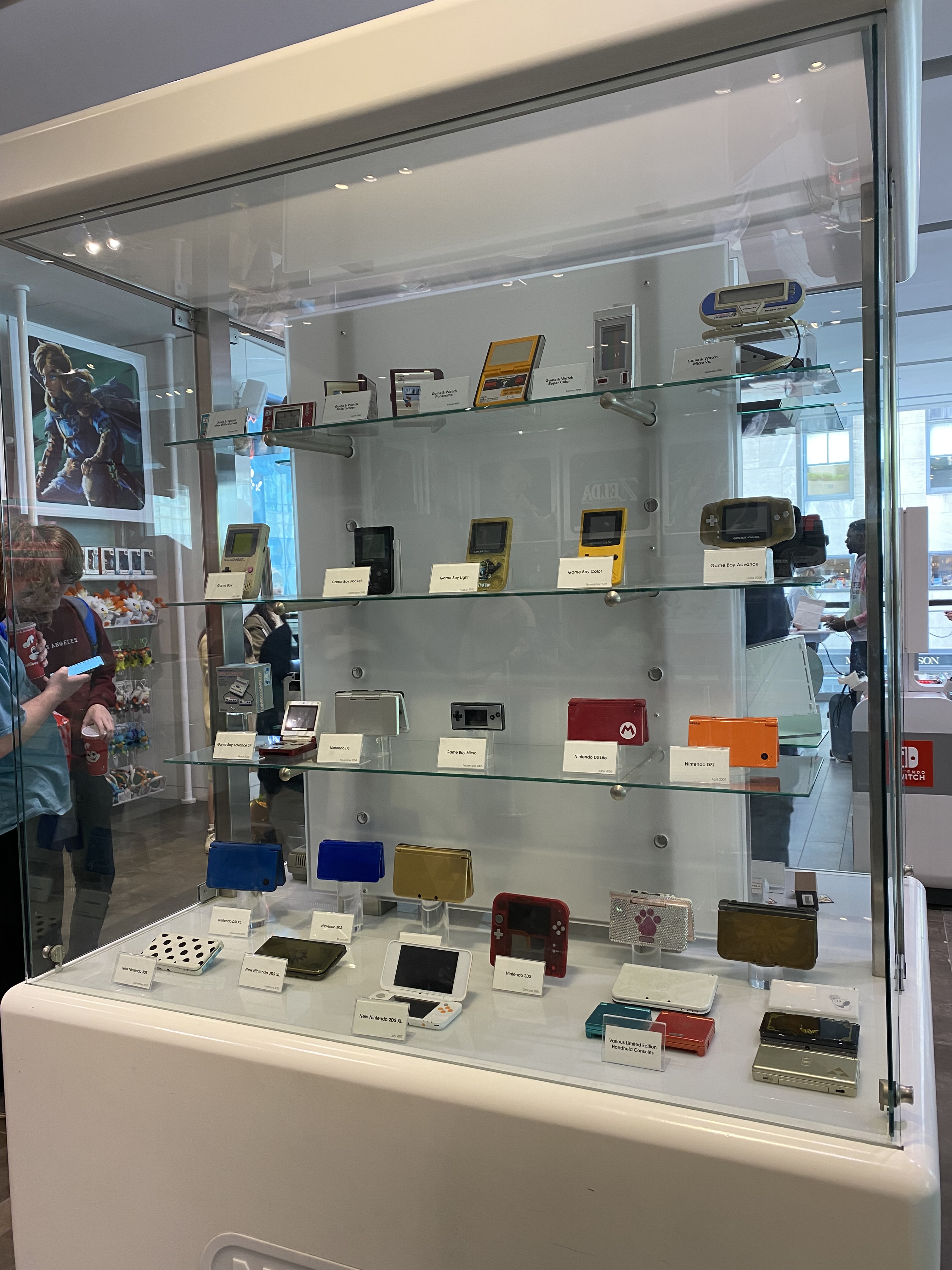
But wait, there’s more! The second floor of the store housed an impressive showcase of Nintendo memorabilia and history. It was like stepping into a time capsule that chronicled the journey of this iconic gaming company. From vintage Game Boy consoles and the legendary Super Nintendo Entertainment System (SNES) to the revolutionary Wii and beyond, I felt a rush of nostalgia as I relived the milestones of Nintendo’s gaming legacy.
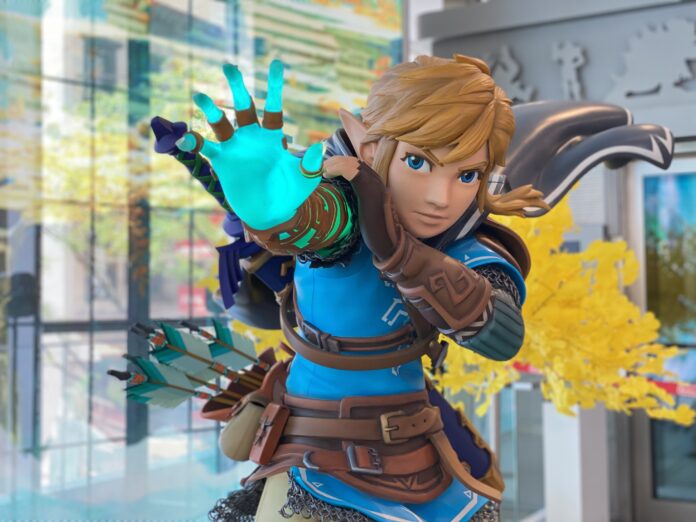
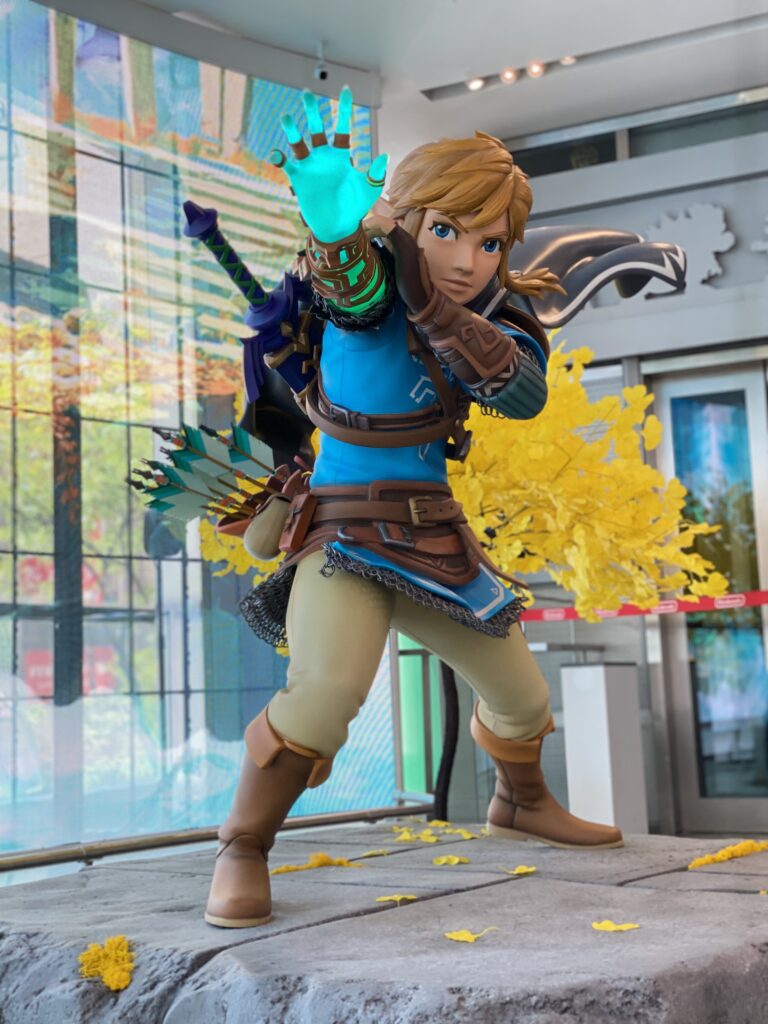
One of the highlights of the second floor was the fact that more than half the floor was taken over by the launch of The Legend of Zelda: Tears of the Kingdom. Just past the museum display was the gaming area, and a gigantic display dedicated to the new Zelda arrival. There was a life-size Link in all his glory, in front of the Tears of the Kingdom logo. Dude!
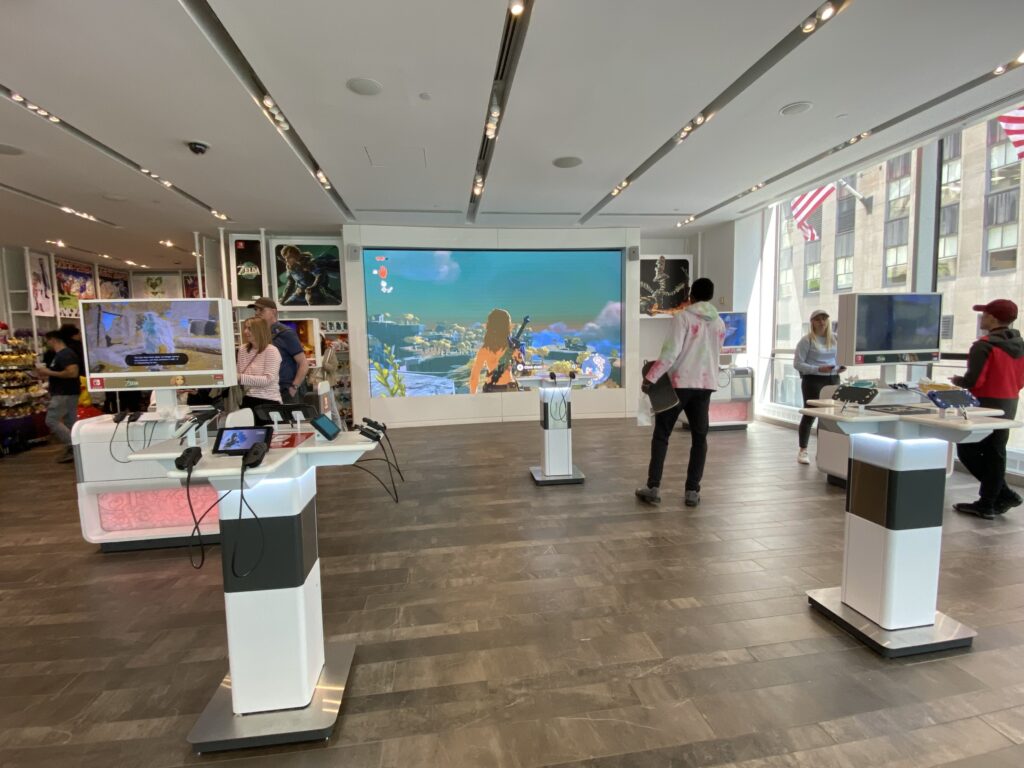
After exploring every nook and cranny of the store, I walked over to the interactive gaming lounge, also on the second floor. Equipped with large screens and comfy seating, this space allowed gamers to indulge in multiplayer battles and engage in friendly competitions. I joined a group of fellow gamers and spent a memorable afternoon battling it out in Mario Kart and Super Smash Bros. It was a fantastic opportunity to connect with other gamers and share our love for all things Nintendo.
As headed back to the first floor, reflecting on my adventure at Nintendo New York, I couldn’t help but appreciate the overall experience the store offered. It wasn’t just a place to buy games and merchandise—it was a celebration of gaming culture and the impact Nintendo has had on generations of gamers.
What sets Nintendo New York apart is the immersive atmosphere and attention to detail. The store staff members, dressed in Nintendo-themed attire, were friendly and enthusiastic, ready to answer any questions and share their love for gaming. They truly made every visitor feel welcome and embraced the spirit of gaming community.
Nintendo New York also hosted special events and tournaments, making it a hub of activity and excitement for gamers. Whether it was a Super Smash Bros. tournament or a Pokémon trading card event, the store provided opportunities for fans to connect, compete, and have a blast together. It’s a testament to Nintendo’s commitment to fostering a sense of camaraderie and shared experiences among gamers.
Before I knew it, the time had come to say goodbye to Nintendo New York. So I headed down the stairs, saying goodbye to Mario who was sliding down the flag pole. But the memories and the magic of this gaming wonderland will stay with me forever. The store is a must-visit for any gaming enthusiast, whether you’re a die-hard Nintendo fan or simply appreciate the joy and creativity that gaming brings. Oh, and that’s when I noticed it. There was another gigantic display that I completely missed on my way into the store. Encased in plexiglass was the…sorry…not going to spoil it. If you want to know, you’ll have to visit the store.
So, if you find yourself in the heart of New York City, make sure to carve out some time to visit Nintendo New York. Lose yourself in the nostalgia, immerse yourself in the world of gaming, and revel in the excitement that this store has to offer. Trust me, you won’t be disappointed. Until then, keep gaming and stay geeky, my friends!
Disclaimer: This article is purely based on my personal experiences and observations. The availability of products and features may vary over time. It is always recommended to check the official Nintendo New York store website or contact them directly for the most up-to-date information.
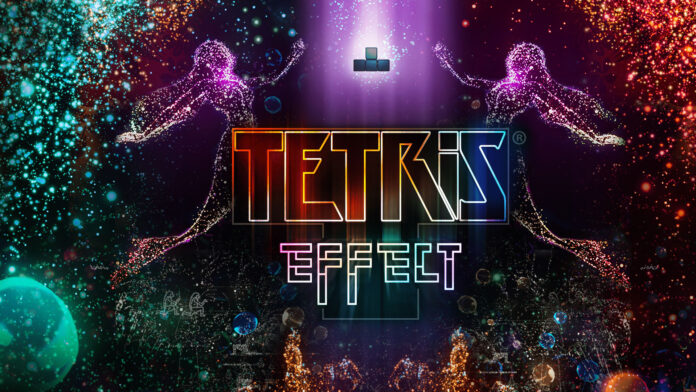
In the vast landscape of gaming history, few names resonate as powerfully as Tetris—the puzzle game that captured the hearts of millions around the world. Now, Tetris Effect, the brainchild of visionary game designer Tetsuya Mizuguchi, brings this iconic classic back to where it all began—Nintendo, the home of gaming innovation. Developed by Monstars Inc. and Resonair, Tetris Effect is more than just a game; it’s a transcendent audio-visual experience that pays homage to the original while pushing the boundaries of gameplay. In this article, we’ll explore the rich history of Tetris, delve into Tetsuya Mizuguchi’s influence on the game, and celebrate the long-awaited reunion of Tetris and Nintendo on the Nintendo Switch.
Here’s the official launch trailer:
The Birth of a Legend: The Origins of Tetris
To truly appreciate the significance of Tetris Effect’s reunion with Nintendo, we must rewind the clock to the early 1980s. Tetris was the brainchild of Russian computer engineer Alexey Pajitnov, who developed the game in 1984. It quickly gained popularity, captivating players with its simple yet addictive gameplay. The release of Tetris on the original Game Boy in 1989 further solidified its place in gaming history, becoming an instant hit and forever linking Tetris with the Nintendo brand.
If you’re interested in the history of Tetris, be sure to check out the AppleTV+ original movie Tetris starring Taron Egerton. Based on the true story of American video game salesman Henk Rogers (Egerton) and his discovery of Tetris in 1988. When he sets out to bring the game to the world, he enters a dangerous web of lies and corruption behind the Iron Curtain.
Ars Technica also has a great short video featuring Alexey Pajitnov and Henk Rogers, where they share some history, game strategies, and trivia on Tetris. . It’s a fun watch for sure.
Tetsuya Mizuguchi: A Game Design Visionary
Enter Tetsuya Mizuguchi, a name synonymous with innovative game design and transformative experiences. Mizuguchi’s career has been defined by his ability to fuse gameplay with sensory immersion, creating games that transcend the boundaries of traditional entertainment. Renowned for his work on titles like “Rez” and “Lumines,” Mizuguchi’s creative genius is unparalleled. Intrigued by the concept of synesthesia—the blending of senses—he recognized the potential to elevate Tetris to new heights by immersing players in a multi-sensory journey.
Tetris Effect: The Evolution of a Classic
Tetris Effect stands as a testament to Mizuguchi’s visionary approach to game design. By infusing Tetris with his signature style, he redefines the very essence of the game. Tetris Effect is not merely a puzzle game; it’s a mind-altering experience that transcends traditional gameplay boundaries. The audio-visual symphony that unfolds as players rotate and stack Tetriminos is mesmerizing, drawing players into a world where sound and visuals dance in harmony with their every move. From underwater realms to breathtaking cityscapes, each stage is a testament to Mizuguchi’s commitment to delivering an unforgettable journey through sensory immersion.
Nintendo Switch OLED: The Perfect Homecoming
As Tetris Effect makes its triumphant return on the Nintendo Switch, the game embarks on a full-circle journey, reuniting with the platform that played a pivotal role in its early success. The portable nature of the Nintendo Switch beautifully echoes the spirit of the original Game Boy, offering players the freedom to indulge in the captivating world of Tetris Effect anytime, anywhere. Whether you opt for the convenience of handheld mode or seek a more immersive experience by docking the Switch to your TV, Tetris Effect on the Switch proves to be an exquisite pairing that seamlessly blends nostalgic charm with contemporary innovation. It serves as a testament to the rich history of Tetris while embracing the versatility and adaptability that the Switch platform has to offer.
The Nintendo Switch, with its vibrant display and adaptable design, provides an ideal canvas for the immersive experience that Tetris Effect brings to the table. Regardless of your gaming preferences, whether you find solace curled up on a couch or prefer the company of friends gathered around the TV, the Switch effortlessly accommodates your desired gaming style. The console’s portable nature ensures that you can carry the enchantment of Tetris Effect wherever you go, inviting others to partake in its captivating beauty and share in the joy of puzzle-solving. By blending nostalgia with innovation, Tetris Effect’s reunion with Nintendo on the Switch exemplifies a harmonious fusion of past and present, paying homage to the game’s origins while embracing the transformative creative vision of Mizuguchi. This fusion creates an extraordinary and magical experience that resonates with players of all generations, inviting them to delve into a multi-sensory adventure that stretches the boundaries of perception and leaves them yearning for more.
The game is now sold as Tetris Effect: Connected. The Connected edition allows you to challenge your friends locally or online. Here’s the the quick recap from Nintendo for more:
PlayStation VR
I recently came across an awesome video on the Nick Robinson YouTube channel featuring Tetris pro Trey Harrison trying out Tetris Effect for the first time. What’s even more impressive is that he played it using a PSVR headset, and his skills actually improved compared to the standard PlayStation version. It’s incredible to see how the combination of immersive visuals and virtual reality elevated his gameplay to a whole new level. Trey’s positive reception speaks volumes about the game’s quality, and I highly recommend checking out the video to witness his mastery in action.
But Which Platform?
The first platform I played Tetris Effect on was the PS5. The sound and graphics are absolutely astounding. If you a PlayStation Plus Extra subscription or above, the game is included for free in the Game Catalog. For all others it retails for US $39.99.
However, when I’m away from my gaming setup at home, I prefer the Nintendo Switch OLED, which I picked up recently. But a word to the wise…If you are a Nintendo Online subscriber, you may be tempted to pick up a digital copy of the game. Before you do, I suggest you read my recommendation at the end of this article.
Final Thoughts
In the vast realm of gaming, few titles hold the same cultural significance as Tetris. With Tetris Effect’s arrival on the Nintendo Switch, we witness a remarkable reunion—a convergence of gaming legends. This iteration breathes new life into the beloved classic, enveloping players in a sensory symphony that pushes the boundaries of gameplay. The Nintendo Switch, with its portable design and vibrant screen, serves as the perfect platform for this reunion, allowing players to embark on a mesmerizing journey wherever they go. Tetris Effect on the Nintendo Switch is a triumph—a testament to the enduring magic of Tetris and a celebration of the visionary minds that continue to shape the world of gaming. So, stack those Tetriminos, lose yourself in the audio-visual splendor, and experience the harmonious reunion of Tetris and Nintendo on the Nintendo Switch. Get ready to be transported to a world where blocks become art and gaming becomes an ethereal adventure.
UPDATE: Digital vs. Physical: The Battle Rages On
In general, I’m not a big fan of digital versions of Nintendo Switch games as they are hard to share with family members and friends, and forget trying to sell them later on. Before I go off on a rant, let me say that the exception is when the Nintendo Online Store offers deep discounts like games for $10 and under. This is not one of those instances, so I recommend opting to buy a physical copy instead.
The physical cartridge is near impossible to find at a reasonable price on most retail sites, and eBay prices can be north of $89 for a brand new sealed game. I recommend heading over to Limited Run Games to buy a cartridge in a case. They have a good selection of games on cartridge that are hard to find as physical media elsewhere. Most importantly, this is where you can find the cartridge version of Tetris Effect for Nintendo Switch at a reasonable price. At the writing of this article, the price was US $39.99 plus shipping. This is also one of those games for collectors, so feel free to add on the protective case for an additional $1.99.
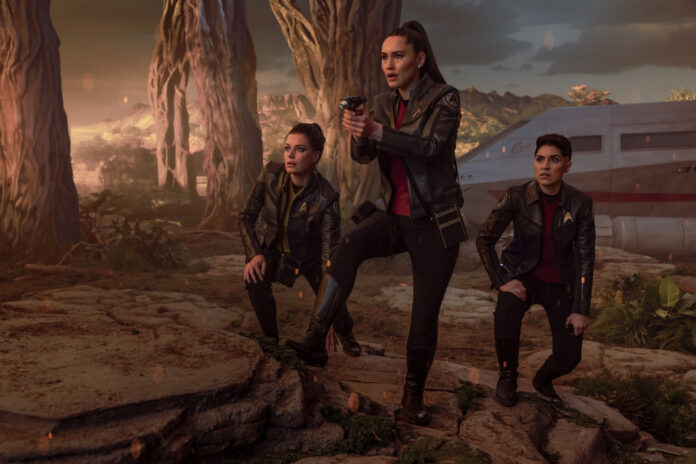
(L-R): Rebecca Romijn as Una, Christina Chong as La’an Noonien-Singh, and Melissa Navia as Erica Ortegas in season 4, episode 1, of Star Trek: Strange New Worlds streaming on Paramount+, 2026. Photo Credit: Jan Thijs/Paramount+
SPOILER WARNING: This article contains major spoilers for “Valles Marineris,” the Season 4 premiere of Star Trek: Strange New Worlds. Don’t read any further until you’ve watched it. That’s it. That’s all I’m gonna say. If you keep reading like a dumbass, don’t say I didn’t warn you.
Okay, so here’s the thing. I thought “Valles Marineris” was really good, and honestly, it might be one of the better episodes this series has done. Not because it tried to be cute, shocking, funny, romantic, scary, or whatever else Strange New Worlds has occasionally thrown at the wall while trying to become the Star Trek show for absolutely everyone.
I mean, that’s all cool and stuff, but damn, I really miss Star Trek: The Next Generation. Season 1 of Strange New Worlds brought back some of those TNG vibes, when exploration and discovery felt like the entire reason we were watching. Somewhere along the way, though, the series started feeling like it was trying on a different costume every week to see what fit.
Not gonna lie, this episode felt a bit different for me, and in a good way. It felt like the show finally found a little bit of the identity it started losing along the way. This is the kind of episode Trekkies like me can rally behind because it’s built around the thing Star Trek has always done best: exploration.
Not just flying somewhere new and scanning a few rocks, either. I’m talking about boldly going where no one has gone before, finding something impossible, and slowly realizing that the discovery is much bigger than the crew first understood. That’s the good stuff, and “Valles Marineris” gives us a full plate of it.
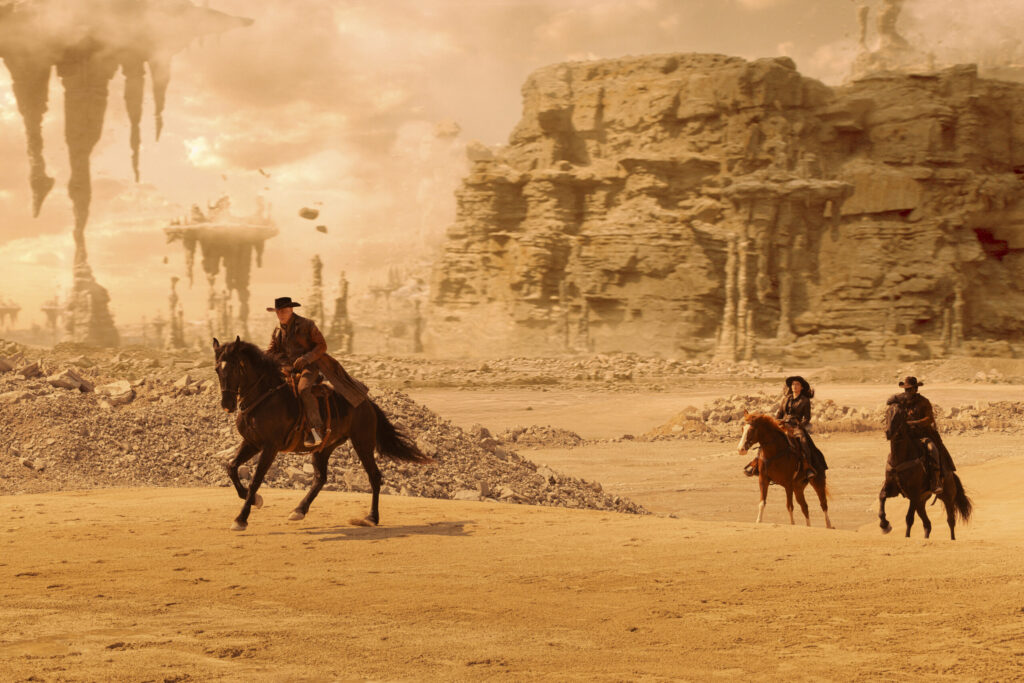
The episode premiered here in the US on Paramount+ on July 23, 2026, as the Season 4 premiere of Star Trek: Strange New Worlds. It starts with horses, a strange landscape, and just enough familiarity to make you wonder what the freak is going on. Then things begin going sideways, and from there, the episode keeps pulling you deeper.
Holo Pursuits, Perhaps
(L-R): Anson Mount as Captain Pike, Christina Chong as La’an Noonien-Singh, and Babs Olusanmokun as Dr. M’Benga in season 4, episode 1, of Star Trek: Strange New Worlds streaming on Paramount+, 2026. Photo Credit: Jan Thijs/Paramount+
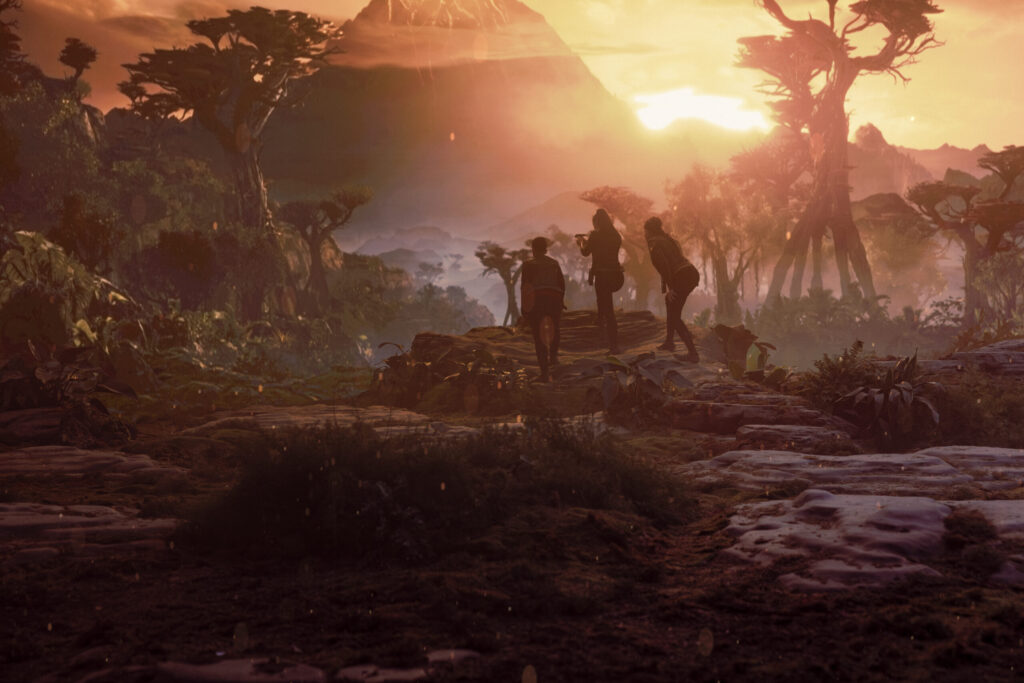
That opening really did fool me for a second. Pike, M’Benga, and La’An are riding through this beautiful landscape, and it has the exact feeling of one of those Next Generation episodes where Picard decides he needs some relaxation and somehow ends up dressed like a 1940s detective. I half expected Data to ride over the hill wearing a cowboy hat and asking everyone to call him “Durango.”
Then I remembered that Pike’s Enterprise doesn’t have TNG holodeck tech yet. That’s probably for the best, since the technology eventually becomes a machine capable of producing anything the human mind can imagine, but mostly uses that power to disable its own safety protocols and trap senior officers inside. Somebody at Starfleet really needed to stop adding features and focus on quality control.
The peaceful horseback ride doesn’t last, because peaceful moments aboard the Enterprise usually mean the universe is winding up its pitching arm. The ship flies into a violent stellar storm, takes a beating, and comes out somewhere that doesn’t look quite right. The stars are wrong, the ship needs repairs, and nobody has a clue where they’ve ended up.
Have We Been Here Before?
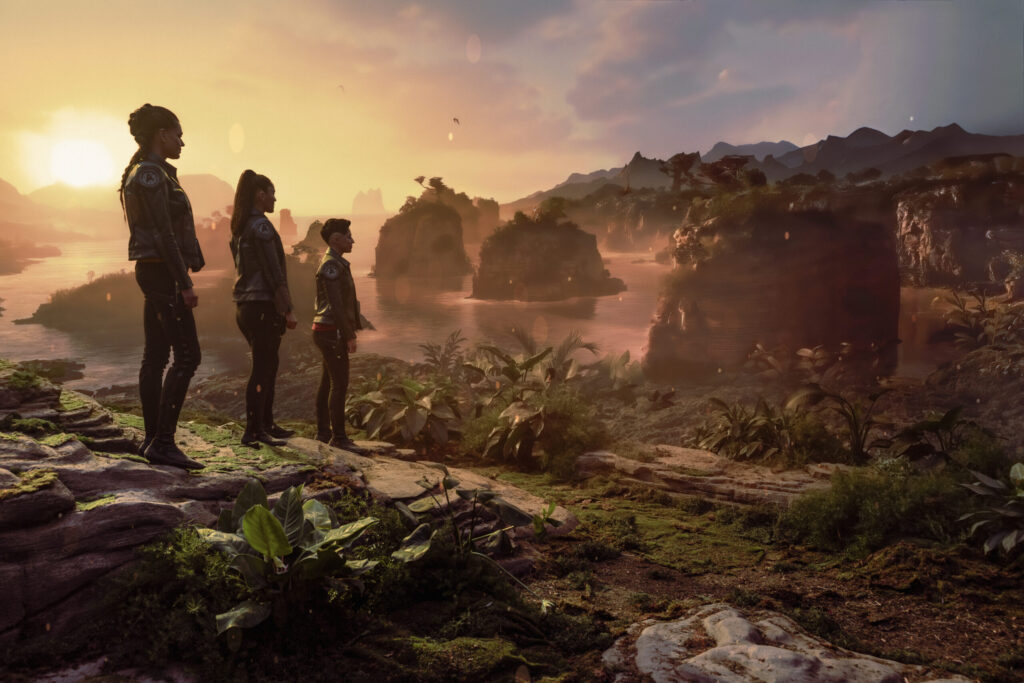
(L-R): Melissa Navia as Erica Ortegas, Christina Chong as La’an Noonien-Singh, and Rebecca Romijn as Una in season 4, episode 1, of Star Trek: Strange New Worlds streaming on Paramount+, 2026. Photo Credit: Jan Thijs/Paramount+
Una, La’An, and Ortegas beam down to collect what the Enterprise needs, and the planet looks like another dangerous alien wilderness. There are enormous animals roaming around, the landing party is suddenly much lower on the food chain, and La’An appears ready to fight the entire planet one creature at a time. Honestly, that tracks for her, given the crazy DNA cocktail flowing through her veins.
The episode doesn’t rush the reveal, which is exactly why it works. It lets us notice the vegetation, the landscape, and the creatures while that little voice in the back of our heads starts asking why everything looks so familiar. Then the answer finally lands, and it’s even better than whatever explanation you were starting to build in your head.
They’re on Earth 65 million years ago, and those giant creatures aren’t aliens at all. They’re dinosaurs, and watching Starfleet officers sprint through prehistoric Earth is exactly as cool as it sounds. Even better, La’An responds to one of them with the universal language of a punch that would’ve made Kirk proud.
She doesn’t exactly send the creature into early retirement, but she definitely gives it something to remember. I felt a little sorry for the poor animal, and then, for some reason, I couldn’t stop thinking that it reminded me of somebody. A second later, it clicked, and suddenly I couldn’t unsee the striking resemblance to a certain senator from Kentucky.
Blue Sky on Mars
While the away team is trying not to become part of the fossil record, Pike discovers that Mars is home to an advanced civilization. This isn’t the dystopian Mars with recycled air, mutated humans, and some corporate lunatic controlling oxygen with an iron fist. There are no three-breasted hookers, no cab driver named Benny, and definitely no Kuato waiting to crawl out of somebody’s stomach. Give these people air damnit! Sorry, I clearly need to get my Total Recall fix with Arnold this weekend.
No, these are actual Martians, and they’re fighting an insect-like species living on a mysterious neighboring home world. Their problem isn’t a rigged air supply or a corrupt regime squeezing the planet dry. It’s a full-scale war for survival, and the Enterprise has just stepped in some serious dino poop.
This is where the episode starts tightening the screws. Pike wants to help because that’s who Pike is, but every new piece of information makes it clearer that the Enterprise has wandered into something much larger than a local war. He can’t simply switch on an ancient machine, give these people air, and fly home in time for Corn Flakes.
The title itself gives us a clue. Valles Marineris is the massive canyon system stretching more than 2,500 miles across Mars, reaching around 120 miles wide and more than four miles deep in places. It was named after Mariner 9, the spacecraft that became the first to orbit another planet and mapped much of the Martian surface in 1971.
Calling Valles Marineris the Grand Canyon of Mars feels almost disrespectful. It’s less like a canyon and more like somebody tried to split the planet open with a planet sized bat’leth. In the episode, that enormous scar begins to look less like a natural formation and more like evidence.
The Martians Finally Believe in Something
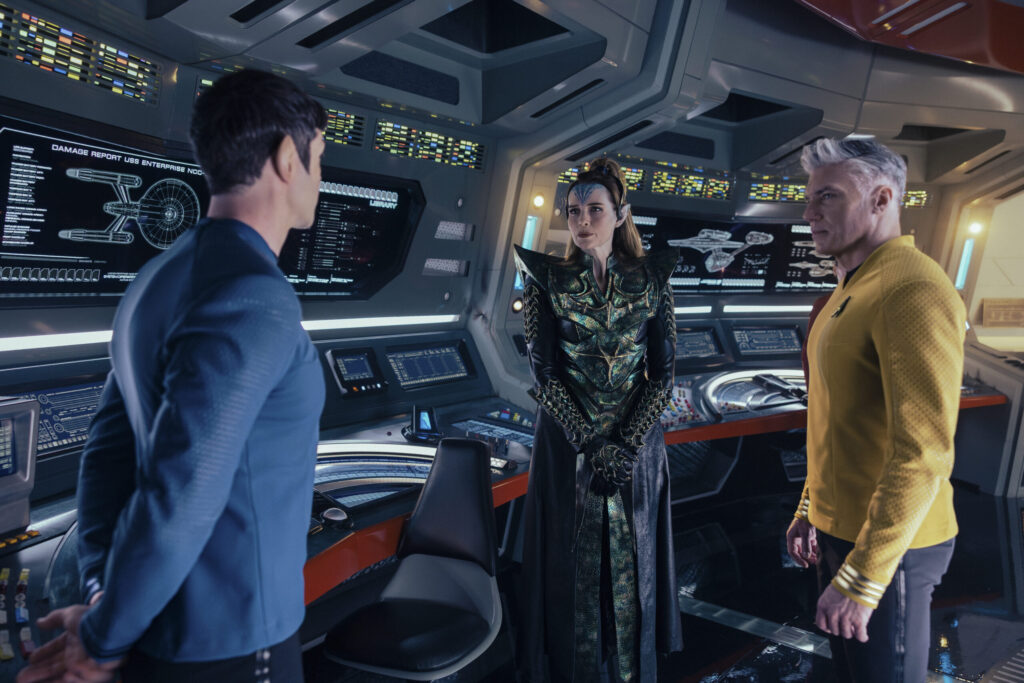
(L-R): Ethan Peck as Spock, Saffron Burrows as Cassell, and Anson Mount as Captain Pike in season 4, episode 1, of Star Trek: Strange New Worlds streaming on Paramount+, 2026. Photo Credit: Jan Thijs/Paramount+
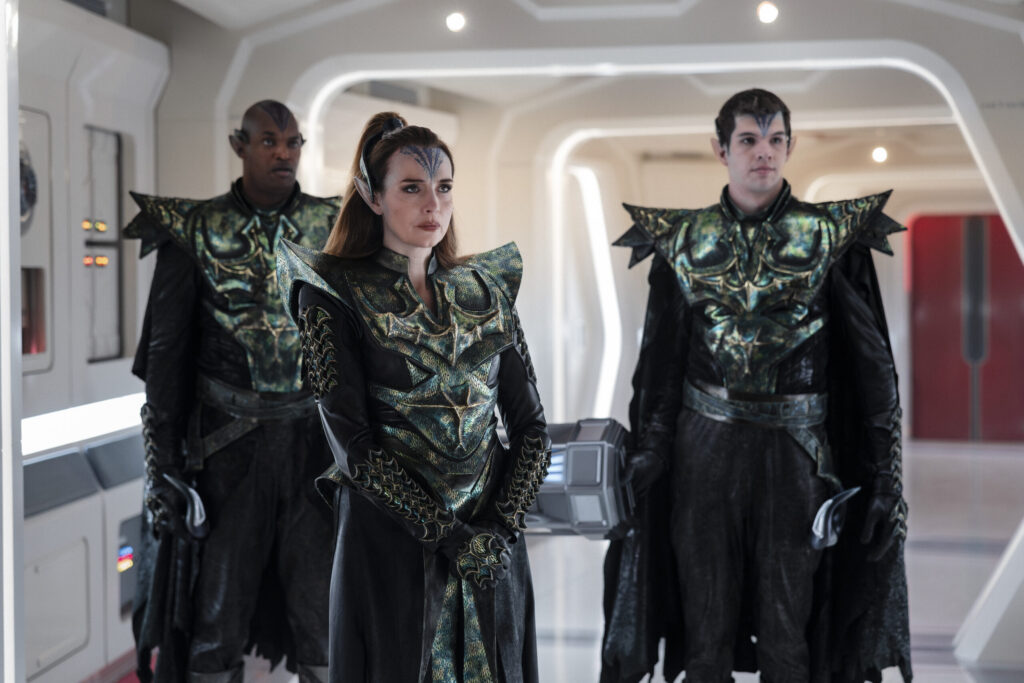
The Martian commander is Cassell, played by Saffron Burrows, and she’s terrific. She gives the character this calm, commanding presence, but you can always feel the suspicion, grief, and exhaustion sitting just beneath the surface. Burrows never overplays it, which makes the moments when Cassell’s defenses begin to fall hit much harder.
Cassell and her people have every reason to be skeptical of the Enterprise. Their first experience with an alien civilization has turned into a brutal war with the insect-like species next door, so they don’t see Pike and immediately think, “Hey, these seem like nice people.” They see another unknown ship, another possible threat, and potentially another species they’ll have to kill before it kills them.
Pike slowly gets through to Cassell by showing her that humanity eventually becomes something better. Humans work beside Vulcans, Andorians, Tellarites, and countless other species instead of trying to wipe each other out every Thursday. For a little while, the Federation becomes proof that her people might survive their fear, end the war, and build something peaceful too.
There’s a little bit of “First Contact” here (The Next Generation, Season 4, Episode 15), where Picard has to convince a frightened civilization that meeting outsiders doesn’t automatically mean losing everything they are. There’s also a touch of “Darmok” (The Next Generation, Season 5, Episode 2), because underneath all the technology, fear, and confusion, the real breakthrough happens when two people stop seeing each other as threats. Pike’s greatest weapon has never been a phaser anyway because it’s his stubborn belief that people can still choose to be better.
Then Cassell figures out just how far into the future the Enterprise has come from, and you can see the hope drain from her face. There’s also a real sense of betrayal in the way she looks at Pike, like he let her believe in a future he knew might never belong to her people. Damn you, Prime Directive!
The peaceful Federation she thought might be waiting just over the horizon isn’t a few years away, a few generations away, or even a few thousand years away. It’s tens of millions of years in the future, and suddenly Pike hasn’t shown her the world her people will build. He may have shown her a world they’ll never live to see.
Burrows plays that realization beautifully. Cassell had allowed herself to believe, just for a moment, that the fighting might end and her people might finally breathe without looking over their shoulders. Then time itself reaches across the room, takes that hope away, and basically tells her, “Sorry, wrong civilization.”
Now the Pieces Start Clicking
Saffron Burrows as Cassell in season 4, episode 1, of Star Trek: Strange New Worlds streaming on Paramount+, 2026. Photo Credit: Jan Thijs/Paramount+
Cassell’s loss of hope is where the emotional story and the enormous science-fiction idea finally collide. Pike realizes that the Enterprise hasn’t merely traveled into the past to watch history happen. The ship and its crew have become part of the chain of events they were trying not to disturb.
That gave me serious “All Good Things…” feelings (The Next Generation, Season 7, Episodes 25–26). Picard spends that story trying to understand a temporal anomaly, only to discover that his own investigation is helping create it. Pike’s facing a similar nightmare here, because every answer the Enterprise finds pulls the crew deeper into the event.
It also reminded me of “Time’s Arrow,” one of my favorite TNG two-parters (The Next Generation, Season 5, Episode 26 and Season 6, Episode 1). Data’s head is found beneath San Francisco centuries before he travels into the past and leaves it there. The evidence exists before the crew experiences the event because time has already closed the circle.
That’s kind of what happens here, only on a solar-system-sized scale. The insect species comes from another planet sitting between Mars and Jupiter, which means there’s an entire fifth world in our solar system that nobody in the future knows ever existed. At first, you’re wondering whether this is some parallel universe or alternate-reality mind twist, but nope, this is our solar system.
Then the insect home world is destroyed and becomes the asteroid belt. What’s wrong, you thought the insect planet was going to survive? This is Star Trek, after all, and we’ve still got several billion years of messy history to explain before Kirk starts ripping his shirt in fistfights.
The destruction of that world also devastates Mars and sends a piece of the wreckage hurtling toward Earth. That impact ends the age of the dinosaurs, opens the door for mammals, and eventually gives us humanity, Starfleet, and the Enterprise. The Enterprise then travels backward and becomes involved in the very events that allowed the Enterprise to exist in the first place.
That’s the best mind twist yet. The future didn’t accidentally change the past because the future was always part of the past. If you’ve got a headache by now, feel free to pop some Advil.
Get Your Ass to Mars
By now, it’s obvious that I’m obsessed with Total Recall. And by that I mean the OG with Arnold Schwarzenegger, not that piss-poor job with Colin Farrell. Although I can’t really complain about Kate Beckinsale. I mean, who wouldn’t want to see a beautifully choreographed, wire-work-heavy hand-to-hand combat sequence between La’An and Kate? Honestly, the writers need to figure out a way to get her into an episode of Strange New Worlds. Where’s Gene when you need him?
Wait! What the hell am I talking about? Let’s get back to the article. Focus, dammit!
Jurassic Finale
(L-R): Rebecca Romijn as Una, Christina Chong as La’an Noonien-Singh, and Melissa Navia as Erica Ortegas in season 4, episode 1, of Star Trek: Strange New Worlds streaming on Paramount+, 2026. Photo Credit: Jan Thijs/Paramount+
Then we get that gorgeous final flyover through prehistoric Earth. The camera sweeps across this enormous living world filled with dinosaurs, and for a moment, the episode just lets us enjoy the sight of it. These creatures have no idea what’s coming, but we do, and that changes the entire feeling of the sequence.
The camera keeps moving until it reaches the T. Rex, standing there like it has been waiting 65 million years for its close-up. It raises its head and lets out that huge roar, bringing the episode just shy of having that blood-sucking lawyer from Jurassic Park kick down Paramount’s doors. Somewhere at Universal, somebody probably stopped chewing, slowly turned toward the television, and reached for the phone.
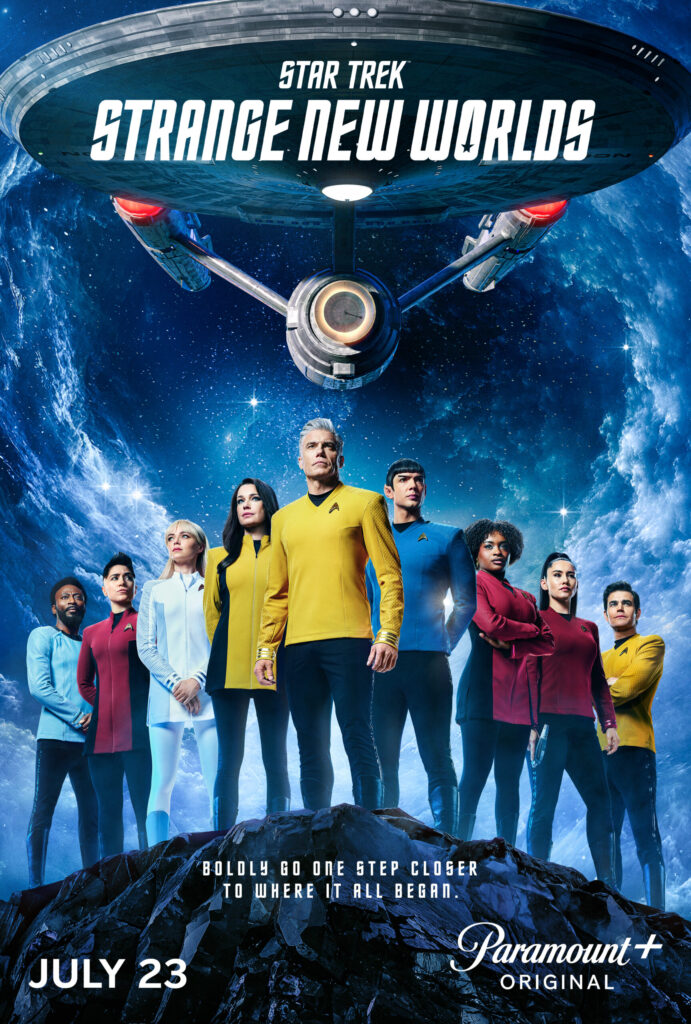
Key Art for Star Trek: Strange New Worlds Season 4, featuring Babs Olusanmokun as M’Benga, Melissa Navia as Ortegas, Jess Bush as Chapel, Rebecca Romijn as Una, Anson Mount as Captain Pike, Ethan Peck as Spock, Celia Rose Gooding as Uhura, Christina Chong as La’an and Paul Wesley as Kirk, streaming on Paramount+ 2026. Photo credit: Paramount+.
It’s funny, spectacular, and surprisingly sad. The dinosaurs started as the coolest part of the adventure, but by the end, they represent an entire world that has to disappear for ours to begin. The episode doesn’t just show us their extinction as a historical fact because it makes us feel the loss.
That’s why “Valles Marineris” worked so well for me. It’s fun, clever, a little ridiculous, and filled with the kind of huge science-fiction idea that Star Trek was built to explore. More importantly, it feels like Strange New Worlds stopped trying to be everything for everyone and simply decided to boldly go somewhere strange again.
Dinosaurs, Martians, impossible choices, and one enormous temporal circle. That’s not just good Star Trek. That’s dino-mite Star Trek, and yes, I’m ending with that because the episode earned it.
“Valles Marineris” is streaming now in the United States on Paramount+. It’s Star Trek: Strange New Worlds Season 4, Episode 1, with new episodes arriving weekly on Thursdays through the September 24, 2026 season finale. Watch it on the biggest screen you’ve got because that final flyover deserves more than something the size of a communicator.
Star Trek Strange New Worlds Season 4 Trailer
In case you haven’t already caught it, here’s the trailer for Season 4:
Buy the Star Trek Movies, Shows, and Gear Mentioned Here
Loved the ideas, characters, and ridiculous Mars detours in this episode? Here are some of the movies, shows, and collectibles connected to everything we talked about.
As an Amazon Associate, AsWellToo may earn from qualifying purchases. These links help support the site, future reviews, and the projects we keep building here, at no extra cost to you.
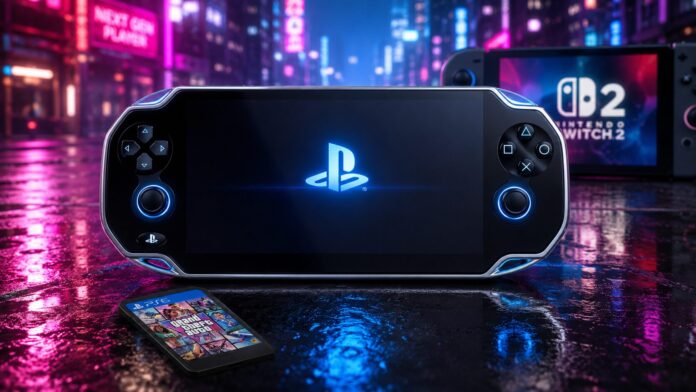
Well, the Switch Effect is in the air, because Sony suddenly can’t stop talking about playing PlayStation beyond the living room. The company hasn’t announced a PS6 handheld, shown a prototype or given us one of those dramatic black silhouettes with blue light leaking from every possible seam, but its latest comments make the direction difficult to ignore.
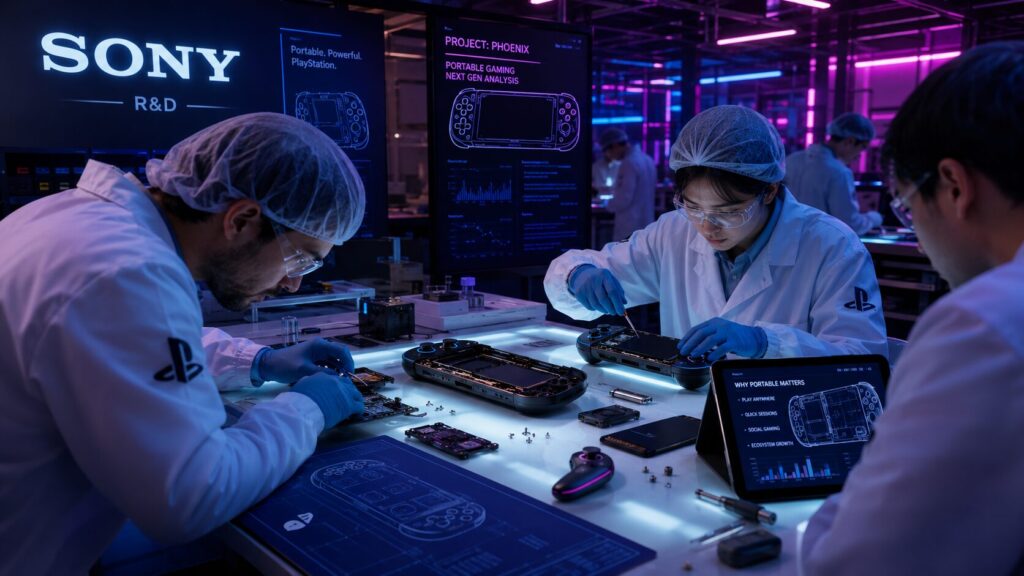
Sony says the next PlayStation needs to support changing play habits, different locations and a more seamless experience beyond the television. It even pointed to the PlayStation Portal as proof that players want PlayStation to travel with them, and at some point a hint stops being a hint and starts standing outside your house holding a DualSense.
A real portable PlayStation could be incredible. It could also become the machine that finally separates PlayStation from one of the most important things a console can still give us: ownership.
Sony Has Seen What the Switch Changed
Nintendo didn’t invent portable gaming with the Switch, but it solved the argument between portable games and console games. You didn’t have to choose anymore, because the same game could move from the television to your hands without losing your save, your controls or the full experience.
That sounds obvious now because the Switch Effect has spent nearly a decade changing what players expect from hardware. Once you’ve played a full console game on a commute, in bed or during ten free minutes between responsibilities, going back to a machine chained to one screen starts feeling strangely outdated.
Sony clearly understands that. A genuine handheld capable of running PlayStation games locally wouldn’t just be another Vita attempt, because it would be Sony admitting Nintendo correctly predicted where console gaming was going.
This Can’t Just Be Another Portal
The PlayStation Portal is useful, but it isn’t the destination. It has excellent controls and a large screen, yet it still depends heavily on Remote Play, cloud streaming and a connection strong enough not to turn a perfect parry into a delayed suggestion.
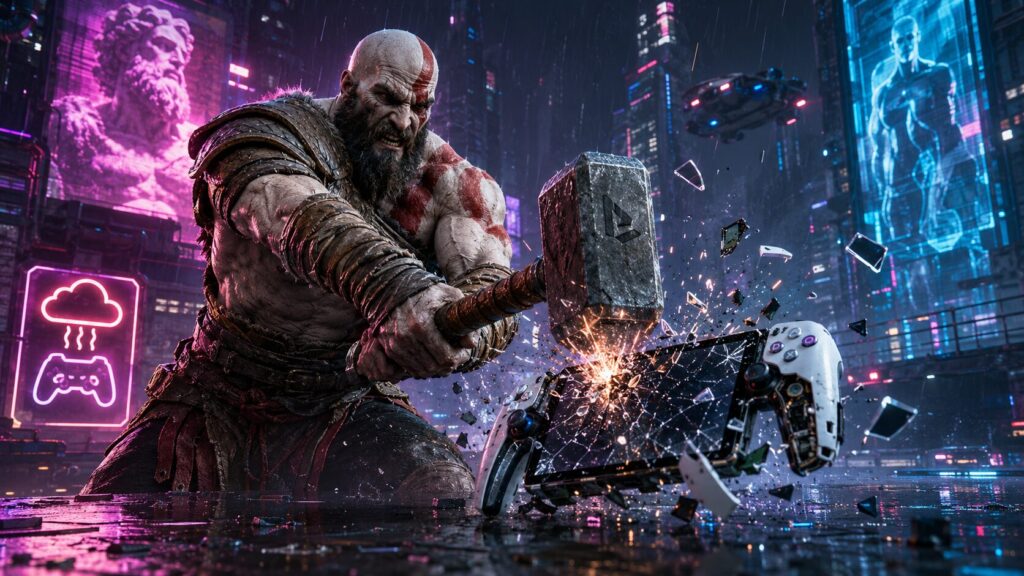
A proper handheld needs to run games locally. I want to download Astro Bot, Ghost of Tsushima or Stellar Blade, put the machine to sleep and continue playing on the train without compression, connection checks or Kratos suddenly moonwalking into a wall because everyone downstairs started streaming their own favorite TV shows all at the same time.
Sony has already argued that dedicated gaming hardware offers more immediate access and better controls than general-purpose devices. That’s the case for a native handheld right there, because the Portal proved people want portable PlayStation and the next machine needs to prove Sony understands why.
PlayStation Games Could Feel Incredible in Your Hands
Imagine a portable system with proper DualSense features, strong haptics, adaptive triggers, full-sized sticks and a good OLED screen. Add instant sleep and resume, expandable storage and enough power to run the same games as the home console with sensible adjustments, and Sony could make something genuinely special.
Astro Bot already uses the DualSense better than nearly anything else on PS5. Put that tactile design into a portable machine and suddenly rain, movement, surfaces and resistance become part of the experience in a way most handhelds still can’t match.
Sony has always known how to build ambitious portable hardware. The PSP was absurdly advanced for its time, while the Vita had an OLED screen, dual sticks and enough strange ideas packed into it to make many modern handhelds look conservative.
The problem was never the hardware. The problem was expensive memory cards, inconsistent support and Sony eventually treating the Vita like it had wandered into the wrong board meeting.
This time, portable PlayStation can’t be a side quest. It has to be part of the main campaign.
The Price Could Be the First Boss Fight
Sony has also made it clear that it doesn’t want to sell future hardware at a significant loss. That’s reasonable business, but it’s also the kind of sentence that makes your wallet quietly leave the room.
A powerful handheld needs a good screen, battery, cooling, storage, durable controls and enough performance to avoid feeling outdated immediately. Sony also has to decide whether it’s a companion to a home PS6, the standard PS6 itself or one model inside a confusing lineup of premium systems and performance tiers.
The smartest version would be simple: one ecosystem, one library and two clear hardware choices. A portable model would prioritize flexibility, while a home console would offer maximum performance, but both would share saves, purchases and full game support.
That sounds obvious. Which is exactly why I’m worried Sony may find a way to make it complicated.
The All-Digital Trap
This is where collectors should start paying attention. Sony increasingly describes PlayStation as a digital platform built around recurring spending, accounts and long-term customer value, while a handheld conveniently removes the expectation of a disc drive.
Nobody expects Sony to bolt a full-sized Blu-ray drive onto the back unless it wants the PS6 handheld to resemble a portable waffle maker. A new cartridge format could solve the problem, but there’s little reason to believe Sony wants to replace discs with another physical medium.
That makes the handheld the perfect machine for Sony’s digital future. Every game would come from its storefront, every license would stay tied to an account and used copies, lending and bargain-bin discoveries would disappear.
The convenience would be real. So would the trap.
Sony Could Win and Still Miss the Point
The frustrating part is that I already want this machine. I want a portable PlayStation with Sony’s controls, its studios and a massive library that fits into parts of my life where the television can’t follow.
That’s the Switch Effect. It isn’t merely attaching a screen to a controller, because it removes the friction between wanting to play and actually finding the time to do it.
Sony could build the portable PlayStation people have wanted since the Vita disappeared. It could also use that same convenience to make players comfortable owning none of the games they carry.
Freedom of movement isn’t the same thing as freedom of ownership. Sony knows how to build the hardware, but the real question is whether it can resist using that hardware to take something away.
Buy the Games and Gear Mentioned Here
As an Amazon Associate, AsWellToo may earn from qualifying purchases. These links help support the site, future reviews, and the projects we keep building here, at no extra cost to you.
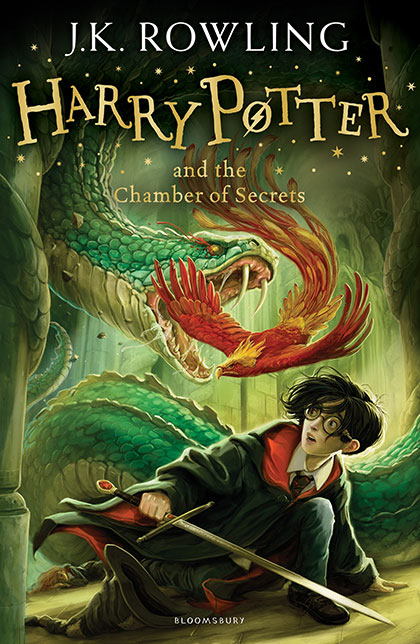
It all started on a delayed train ride, that is where J.K. Rowling first conceived the idea for Mr. Harry Potter. What was originally a middle grade to YA book series, steadily became 8 films, a 3 film spinoff, 1 stage play, around 30 official video games, about 1.3 million fanfics, and now a new official tv series coming out in December. And all of this has consummated into a multi-billion dollar enterprise valued at around $30 billion.
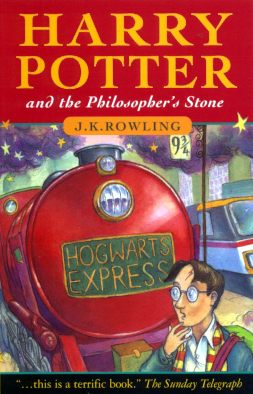
Cover for one of the earliest UK editions
What caused the Harry Potter books to capture an audience long term was the emotional attachment they secretly created. As the reader grew up, so did the characters. That’s why in the beginning, the series worked so well for middle-grade readers, and later on they became something much closer to young adult storytelling. That allowed readers to connect with the characters on a deeper level than many other books could.
Way before the book series was finished the Harry Potter films started coming out. On November 4th, 2001, Harry Potter and The Philosopher’s Stone Premiered. At that time only 4 books of the Harry Potter series were out. From that moment Harry Potter couldn’t be stopped. Not only did it have book fans, but the greatest people of all: movie fanatics.
Here We Go HBO
With the successful launch of the new park at Epic Universe it seems as though everything is fine. But ever since it was announced that Paapa Essie’s would play Professor Snape in the new HBO series, a lot of concern and controversy has surrounded the show.
The issue is not really about whether Paapa Essie’s can act. He is a talented actor, and he may end up being great in the role. The concern is more about how the story will read on screen. Snape is already a character Harry distrusts almost immediately, and if the show is not careful, the way that suspicion plays out could feel very different from how it worked in the books and original films.
Just imagine it. “Oh, Harry, what could possibly tick you off about Professor Snape? Yes, he can be quite hard on us sometimes, but Dumbledore trusts him, so he can’t be evil,” Hermione retorted. “I don’t know…” Harry’s voice quivered. “There’s just something dark about him.” That is the kind of thing some fans are already worried about. The show now has to handle those early Snape scenes carefully, because the casting changes the way certain moments may land with modern audiences. It does not mean the show is doomed. It just means HBO has to be very aware of what it is doing.
Not only that, but now the actress for Ginny Weasley has left, and only going to be in the first season due to “unforeseen circumstances,” she and her family stated. This is just before the second season, where Ginny Weasley would have a huge role. Many fans are disappointed, as the actress seemed like a perfect choice, and she has now missed this chance for a “big break.” However, fans have ultimately decided to support her decision. After all, she is an 11-and-a-half-year-old little girl, and not Brad Pitt.
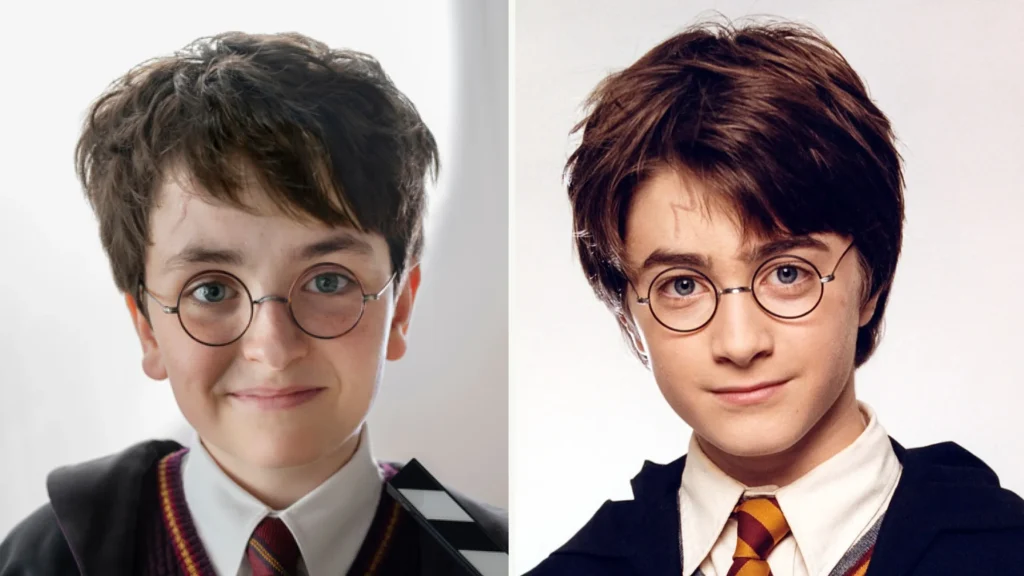
Courtesy of HBO (L), Warner Brothers/courtesy Everett Collection (R)
Next, people are upset at style changes made, such as the house crests and redesigned robes, which some fans feel they lack clear house identification and move away from the style they expected from the books. Since this new HBO series is being sold as a more book-accurate version of Harry Potter, fans are naturally watching every costume, crest, wand, hallway, and detail like detectives.
Also, this isn’t an issue that people are really talking about, but I would just like to acknowledge that the new actor for Draco Malfoy, Lox Pratt, is listed as 5’6″. So the entire show, he will be TOWERING over every other student, most of whom are listed to be around 4’8″ to 4’9″. Although, unlike the other young students, Lox Pratt is 14 years old, not 11. He is also going through a growth spurt. Personally, I think his extensive height will be great for intimidation, since early in the series Draco is meant to be intimidating, smug, and untouchable. Not only is he taller than Harry Potter, but he’s also already taller than some adults, including me. Anyways, overall, Lox Pratt does seem like a strong choice for the role of Draco Malfoy, and we are all excited to see how he does.
Your Turn J.K.
It is impossible to talk about the future of Harry Potter without talking about J.K. Rowling. Over the years, Rowling has become one of the most controversial parts of the franchise. Many fans and critics have accused her of making transphobic comments because of her views on gender identity, inclusive language, and laws involving gender recognition. Rowling has defended her views by saying she is concerned with protecting women’s sex-based rights, but for many former fans, the damage has already been done.
Illustration by Stephen Collins
There have also been long-standing criticisms about representation in the original books. Readers have pointed out that the series has very few major Black characters, and the name Cho Chang has been criticized for feeling stereotypical and careless. Whether people see these choices as intentionally harmful or simply poorly handled, they have become part of the larger conversation about how the Wizarding World represents different groups of people.
This is why the idea of “separating the art from the artist” has become so complicated with Harry Potter. For some fans, the story still means too much to let go of. For others, Rowling’s public views have made it hard to enjoy the franchise the same way. Either way, HBO and the future of the Wizarding World cannot ignore the fact that Rowling’s controversy is now tied to the franchise’s legacy.
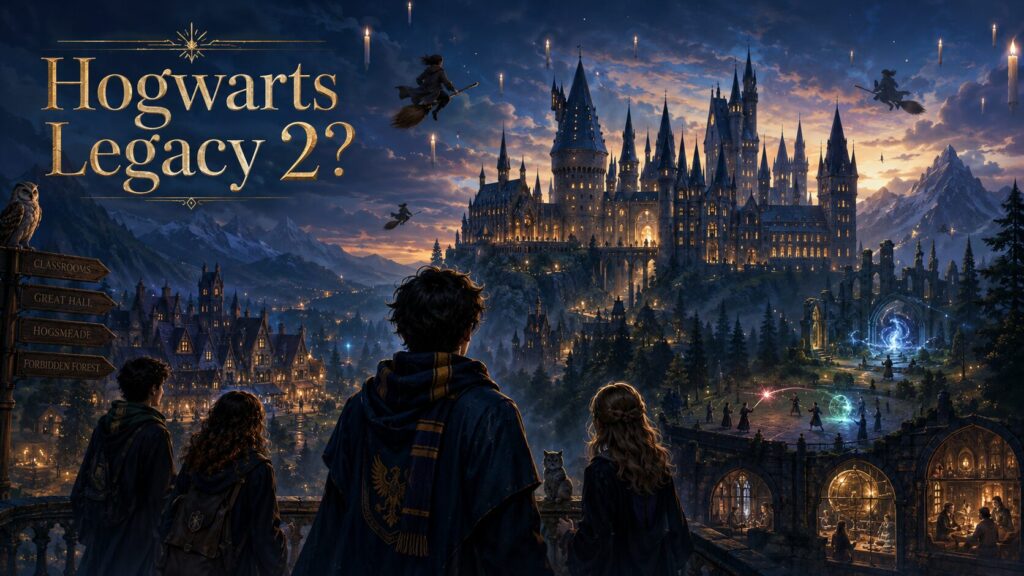
Hogwarts Legacy 2…When?
Now, some people hated Hogwarts Legacy, but a lot of people LOVED it, including me. First off, the visuals were incredible. For the first time ever, we were able to fully see and explore the entirety of Hogwarts, as well as Hogsmeade and so many other iconic spots. The side quests were phenomenal, and you got to be friends with such wonderful characters. Also, several people fell head over heels for Sebastian Sallow and Ominis Gaunt.
Now, the only things people consistently disliked about the game were pretty clear. First, you spent a lot of time outside of Hogwarts for a game that is literally called HOGWARTS Legacy. The outside areas were beautiful, but fans wanted more time inside the school. They wanted classes, hallways, secrets, common rooms, student life, and the feeling of actually living at Hogwarts.
The other thing was the main storyline. Everyone loved the side quests, but the main story was not the most fun. It was definitely a story, but it definitely felt more like homework and less like a magical journey. Part of the reason it felt that way I believe is because you were not really going through it with a core group of friends. Something iconic about Wizarding World stories is that it is usually a group of friends going through the journey: Harry, Ron, and Hermione. Newt, Jacob, and Tina. And, of course, in Hogwarts Legacy, some of the best moments can from the side mission with you, Sebastian, and Ominis. The next game needs more of that.
With Hogwarts Legacy 2 confirmed and apparently in development, fans have a lot of requests. One of the craziest things they have asked for is romance, which I’m not against. Something amazing that the first game did was give us characters we’ve never known and make us love them so much. That means the sequel should lean into relationships, friendships, rivalries, and choices that actually matter.
Next, we definitely need a better main story. People also want more Hogwarts time. They want to go to classes more. Basically, they want a Hogwarts life simulation, which I’m also not against. I have spent over 200 hours playing this game, and I will say that classes were weirdly so fun. I personally would be okay going through high school again if it meant it was at Hogwarts. Something I think would be cool to add is having the ability to become Head Girl or Boy, or even a prefect. Another thing they definitely must do is add new places. Some recommendations are London, Diagon Alley, and the Ministry of Magic.
I would also love for them to try including other schools. I would love to be able to explore or visit, in a small way, Ilvermorny, Beauxbatons, and Uagadou, even if it is only in a small way. It would also be cool to meet students currently in attendance there. When I visited Epic Universe, I loved being able to meet the wizarding students, and that kind of detail could work perfectly in a game.
I also think it would be cool to get a job, whether it was official, like working at the Ministry of Magic, or unofficial, like tutoring or pet sitting. I think we should also have access to more spells and potions, such as the Polyjuice Potion. Maybe if we could do that whenever, that would be great. Obviously, it would take forever to brew, but that is part of the fun.
And finally, my last request, which is rarer, is a game that looked like Hogwarts Legacy but during the time of Harry Potter and/or Newt Scamander. That may be harder to pull off, but fans would absolutely show up for it if it was done right.
Now What Needs To Be Fixed
Courtesy Bloomsbury
Obviously, they need to nail Hogwarts Legacy 2. Otherwise, they’re going to not only lose a lot of money, but also a lot of fans. With the first game being such a hit, but still needing a lot of fixes, a lot is riding on the next game.
Next, they have to stay true to the original books for the new HBO series, but they should also expand. The show needs more depth and character growth, especially for characters who were not always given enough time in the original films. Something I know a lot of fans have wanted is for Draco Malfoy to have more redemption, or at least more emotional complexity.
Also, either during the show or separately, they should make new stories that the fans actually want. Voldemort’s upbringing. The story of the three Black sisters. And obviously what the fans call The Marauders. In the meantime, there are several fan films on YouTube that can fill that space until something official.
Next, it has been stated that Hogwarts Legacy 2 will connect to the new HBO series. The only ways to do that, which I have come up with, are: 1) a new mystery is added to the show that is not canon to the books; 2) Hogwarts Legacy 2 takes place during Harry Potter’s year and not the 1800s; or 3) Hogwarts Legacy 2 will somehow give backstory to something during Harry Potter’s time, such as Voldemort, the Black family, or The Marauders.
Also, if Hogwarts Legacy 2 wants a successful release, it should not disappear for too long. Preferably it should be released either in 2027 or late 2026, and with no new news in sight, it’s slowly fans are losing interest for a second game.
Finally The Solution
Reilly Brown- Harry Potter Fanart- Wikimedia Commons
Do right by the fans. That’s all they need to do.
Anytime a fandom has issues, the best solution is to listen to the fans. Not every fan idea should be used, obviously, but when there is a clear pattern in what people are asking for, the franchise should pay attention. Right now, the requests are not that complicated or outlandish.
1) Release Hogwarts Legacy 2, or at least a trailer with a clear and close release date.
2) Make sure the HBO series is book-accurate, but also adds character depth to those who aren’t The Golden Trio: Harry, Ron, and Hermione.
3) Start making stuff that isn’t reboots and is original, such as Voldemort’s story or The Marauders.
4) Create more inclusivity and diversity in a way that feels natural, respectful, and accurate to what Hogwarts would actually be if it were real.
During the films, I saw moments where different cultures were underrepresented or misrepresented. If Hogwarts is supposed to be a magical school connected to a larger magical world, then that world should feel larger. Better representation would not only make more fans happy and interested, but it would also make the world feel more real and emotionally impactful.
If the Harry Potter franchise can do this, then all their problems could be fixed. The fans want true escapism. They want to be absorbed, and they want to feel the magic, not just see it. What the franchise needs to do immediately is release something the fans can believe in again. Something polished. Something thoughtful. Something that tells the fans, “Trust us.”
I think what we all have to do is take a breath. All of this craziness is over a kids book. I’d be lying if I left it at that. This kids’ book has had the ability to inspire more than one generation. It’s allowed so many to breathe magic and almost live inside the impossible. That’s something worth protecting, and it’s a reason why Potterheads take this all so seriously.
That is why Harry Potter needs to lock in. Because it’s so much more than kids books, movies, or games. Harry Potter has truly become a way to live. It’s a community. It has become one of the biggest fandoms in the world, right up there with Marvel and DC.
From one train ride in London came a piece of art that became globally renowned. Hundreds of millions of fans. Whether you’re a brave Gryffindor or a stylish Slytherin, Harry Potter is a part of you.
And the fans of today, along with the fans from before, are still on the ride of a lifetime.
Buy the Books, Games, and Gear Mentioned Here
As an Amazon Associate, AsWellToo may earn from qualifying purchases. These links help support the site, future reviews, and the projects we keep building here, at no extra cost to you.
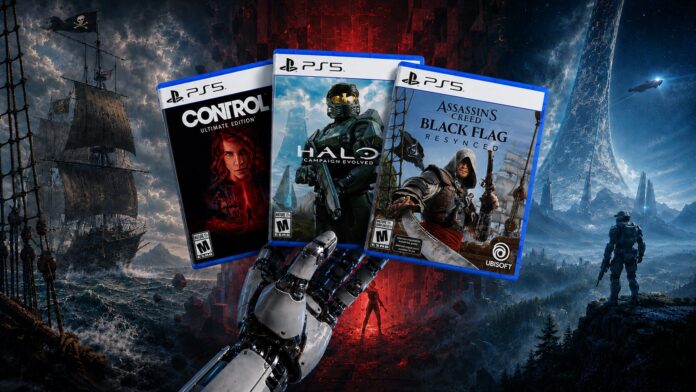
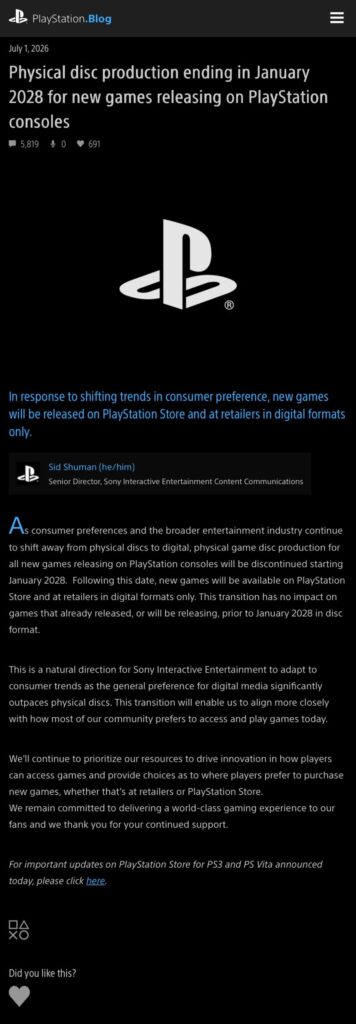
Happy 4th, and boy, were there fireworks after PlayStation’s announcements. July is usually where the gaming calendar goes to take a nap, but 2026 feels different because physical games are under attack. Honestly, every physical edition is basically a collector’s edition from now on because the clock is ticking. With Sony saying new PlayStation game disc production ends in January 2028, every boxed release suddenly has this weird last-call energy around it. Not because every disc is rare, not because every case is sacred, but because “physical” needs a closer look now. Is the full game on there? Is it complete? Does it need a massive download? Or is it just a code in a plastic case wearing a physical game costume?
That’s why these three big PS5 physical releases stand out this month. They’re not all the same kind of “physical,” and that’s honestly the point.
Assassin’s Creed Black Flag Resynced
If Ubisoft was going to bring back one older Assassin’s Creed game for the current generation, Black Flag makes all the sense in the world. It’s the one people still talk about even when they’re tired of Assassin’s Creed. It’s pirates, ships, sea shanties, tropical water, jungle ruins, and Edward Kenway being the kind of messy protagonist who makes a long open-world game feel like a real adventure.
Assassin’s Creed Black Flag Resynced releases July 9, 2026, for PS5, Xbox Series X|S, and PC, according to Ubisoft’s own store page. Ubisoft describes it as a remake rebuilt from the ground up on the latest Anvil Engine, with updated visuals, upgraded gameplay mechanics, and new content specific to this version.
That sounds exciting, but the physical angle is where things get a little spicy. Ubisoft’s page says a one-time internet connection is required to download the game, and after that, the full main campaign is playable offline. That wording matters. It means this is not the cleanest possible “pop in the disc and play forever” situation, but it’s also not being presented like a pure cloud rental or a useless box with nothing behind it.
And this is exactly why physical coverage has to get more specific now. Five years ago, most people would just ask, “Is there a disc?” Now that’s not enough. You have to ask what’s on the disc, what has to be downloaded, what still works offline, and whether the version you’re buying today is something you can reasonably expect to play later without begging a server to remember you exist.
As a game, Black Flag is an easy one to care about. The original had that rare open-world thing where the best moments were not always the main missions. Sometimes the best part was just sailing into trouble, hearing the crew sing, spotting a storm, and deciding, “Yeah, this seems like a terrible idea. Let’s do it.” If Resynced keeps that feeling but tightens up the combat, mission design, visuals, and performance, this could be one of the more satisfying nostalgia plays of the summer.
But as a PS5 physical release, it also feels like a test case. This is a major publisher, a beloved game, and a big retail release landing right after Sony basically put an expiration date on future PlayStation discs. That means the box matters. The disc matters. The download requirement matters. The offline campaign note matters. The tiny fine print is no longer tiny.
CONTROL Ultimate Edition
CONTROL is one of those games that doesn’t look like it should work as well as it does. On paper, it’s a third-person action game set inside a weird government building. In practice, it feels like someone turned a haunted office, a physics playground, and a superhero power fantasy into one very stylish game.
The PS5 physical re-release of CONTROL Ultimate Edition is listed for July 10, 2026, at GameStop and Video Games Plus. GameStop lists the PS5 version at $29.99, while VGP lists the same July 10 release date and describes the package as including the main game plus the previously released expansions, The Foundation and AWE.
That “Ultimate Edition” part is the whole reason this belongs in a physical collector article. CONTROL was already a great game, but the complete version matters more because this is the kind of game where the DLC isn’t just extra seasoning. The Foundation and AWE expand the world, deepen the weirdness, and give the whole package that “okay, this is the version I actually want on my shelf” feeling.
It also helps that CONTROL is very much a game about feel. Jesse throwing chunks of concrete at enemies never gets old. The Service Weapon has that strange, chunky snap to it. The Oldest House bends around you in ways that make the whole game feel unstable, like the building itself is loading a new thought every time you turn a corner. When this game is running well, it has that rare next-gen upgrade feeling where the performance and visual polish actually support the mood instead of just making the puddles shinier.
For PS5 owners who missed the earlier physical release, this reissue is the type of thing that could quietly become more interesting later. It’s not a new game, it’s not a sequel, and it’s not the kind of release that takes over the internet for a week. But it is a complete edition of a highly respected modern game coming back to disc at a time when discs are starting to feel less guaranteed.
Halo: Campaign Evolved
This one is still wild. Halo on PlayStation used to sound like the kind of thing someone would say on a message board just to start a fight. Now Halo: Campaign Evolved is launching on PS5 on July 28, 2026, with early access beginning July 23, according to PlayStation and Halo Waypoint.
There’s the obvious headline, which is that Halo is on PlayStation. That alone is strange enough. It’s like seeing Mario walk into a PlayStation Showcase and ask where the bathroom is. But the bigger physical-media angle is more complicated, because Halo Studios has been pointing out physical discs, while reports have also noted that the box suggests a content download is required.
As a game, Campaign Evolved has a lot to prove. Halo: Combat Evolved is one of those games where people don’t just remember the levels. They remember the feeling of walking out onto Halo for the first time. They remember the music coming in. They remember the enemy AI, the chunky grenades, the rhythm of plasma pistol, battle rifle, melee, repeat. It was clean, readable, physical, and weirdly elegant in a way a lot of modern shooters still chase.
A remake can’t just look prettier. That’s the trap. If Halo: Campaign Evolved turns into a glossy museum version of Halo, it’ll be interesting for one night and forgotten by the weekend. It has to feel right in the hands. The movement has to have weight. The weapons need personality. The Elites need to feel like they’re reacting, not just standing in the room waiting for you to clear the encounter. Halo was never only about the ring. It was about the combat sandbox.
For PS5 players, this is also one of those bizarre full-circle moments. PlayStation owners are getting a major Xbox icon on disc during the same window where Sony is telling everyone the future won’t be built around discs anymore. That contradiction is almost too perfect. The old console war symbol is showing up in a blue box, while the blue-box company is preparing to phase out the very format that makes the moment feel collectible.
Why These Lists Matter Now
This is why physical release lists can’t just be shopping lists anymore. They used to be simple. Here are the games. Here are the dates. Go buy the ones you want. Done. Now they have to be more like little ownership reports. A game having a box does not mean enough. A game having a disc does not always tell the whole story. A game being playable offline, complete on disc, partially on disc, or tied to a required download can change whether that release is a nice shelf piece, a preservation win, or just a plastic receipt.
That doesn’t mean every digital game is bad, and it doesn’t mean every physical collector needs to turn into a doomsday bunker guy with alphabetized steelbooks. Digital is convenient. It’s fast. It’s how a lot of people actually play. But convenience shouldn’t erase choice, and it definitely shouldn’t make ownership feel like a premium feature from the past.
That’s why this stuff is worth tracking. Not because every box is sacred. Because games are culture, and culture gets weird when the only version left is the one a storefront lets you access. Physical games are not perfect, especially now, but they still shed light on a dark future where buying feels more like renting.
Buy the Games and Gear Mentioned Here
As an Amazon Associate, AsWellToo may earn from qualifying purchases. These links help support the site, future reviews, and the projects we keep building here, at no extra cost to you.
There are few games Nintendo can bring back that instantly make people lose their minds the way The Legend of Zelda: Ocarina of Time can. This is not some random catalog title getting dragged out of the attic because someone found the source code next to a dusty GameCube memory card. This is Ocarina of Time. This is the game people still bring up when they want to talk about the greatest games ever made, the one that taught an entire generation what a 3D adventure could feel like, and the one Nintendo has been strangely careful with for years.
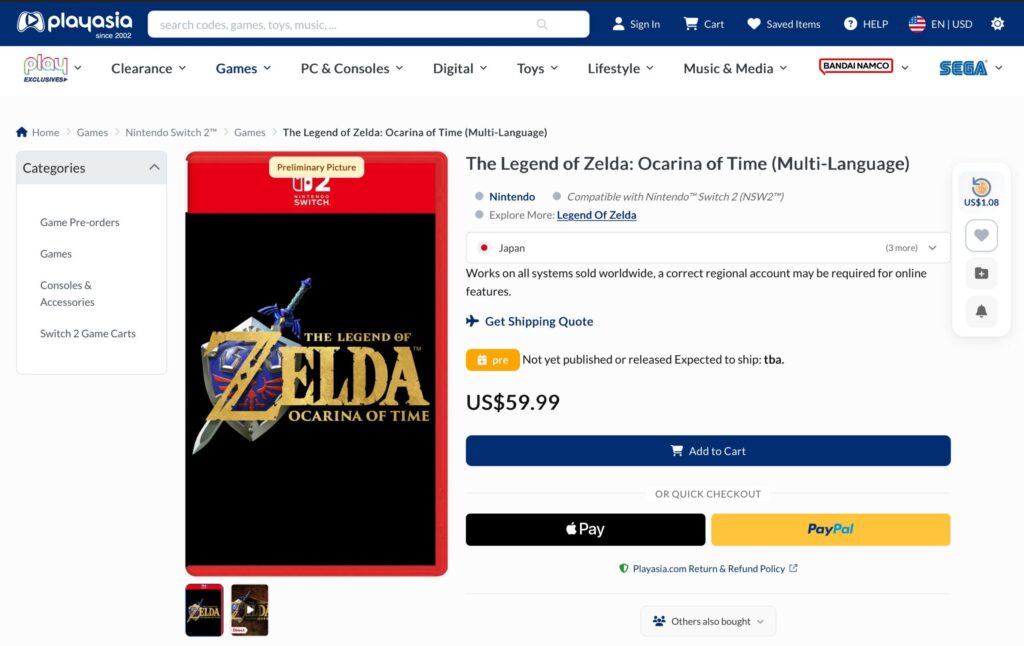
That is why PlayAsia’s listing for The Legend of Zelda: Ocarina of Time on Switch 2 at $59.99 feels more interesting than it probably looks at first glance. Nintendo has not officially announced the final price, so nobody should treat this as confirmed MSRP. Retailers can change listings, correct mistakes, and handle preorders in different ways before release. But this also does not look like a meaningless placeholder. It’s an active preorder listing at a normal retail price, and that makes the number worth paying attention to.
And if the price is a clue, then I’m starting to worry.
PlayAsia’s Listing Is Not Official, But It Is Worth Noticing
The obvious caveat matters here: PlayAsia is not Nintendo. A retailer listing is not the same thing as Nintendo showing up on a Direct saying, “Yes, this is the price.” There are plenty of ways a listing can shift before launch, especially when a game still has a TBA release window and Nintendo has not put out the official pricing itself.
But there is also a difference between a throwaway placeholder and a normal-looking preorder price. This is not some ridiculous $99.99 “we’ll figure it out later” listing. It’s on their home pace for crying out loud. It looks like an actual retail price for a physical import version, and that makes it fair to ask what Nintendo’s pricing strategy might be telling us. It doesn’t prove the scope of the remake, but it gives us a clue worth discussing.
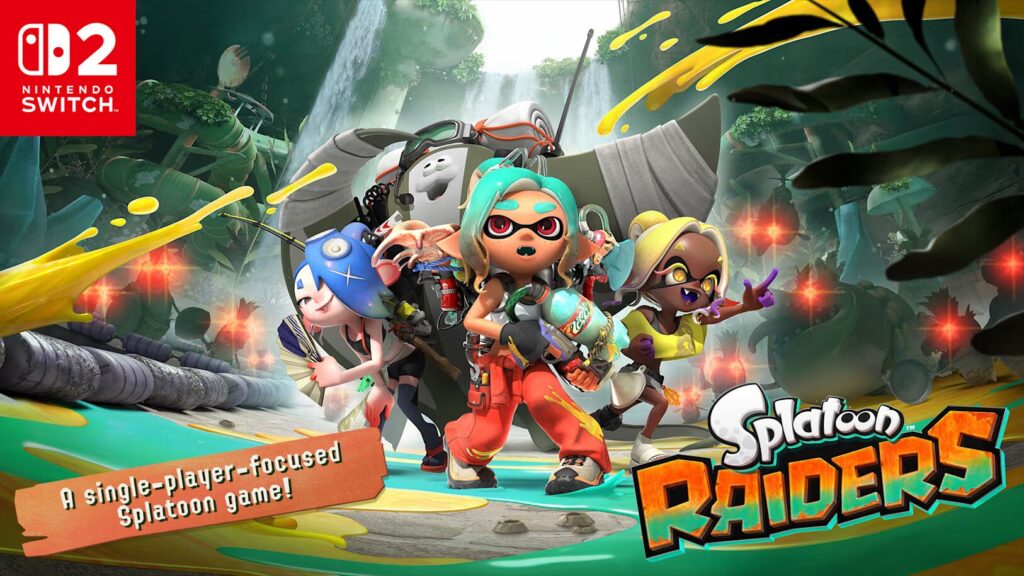
Splatoon Doesn’t Help Us Understand This
Screenshot and art via Nintendo
The cleanest comparison here is not Splatoon Raiders, or whatever else Nintendo has floating around the Switch 2 schedule. Splatoon is its own weird animal. It has online value, community value, possible content updates, multiplayer expectations, and a completely different kind of pricing logic. Trying to use Splatoon as the measuring stick for Ocarina of Time is like trying to compare Mario Kart to Mario Odyssey. They both have Mario in the Nintendo family photo, but nobody expects them to be priced, built, or judged the same way.
That is why Splatoon feels like noise in this argument. It may matter for Nintendo’s broader Switch 2 pricing picture, but it does not really help us understand what kind of remake Ocarina of Time might be. For this specific conversation, there is one comparison that makes a lot more sense.
Star Fox Is the Comparison That Actually Matters
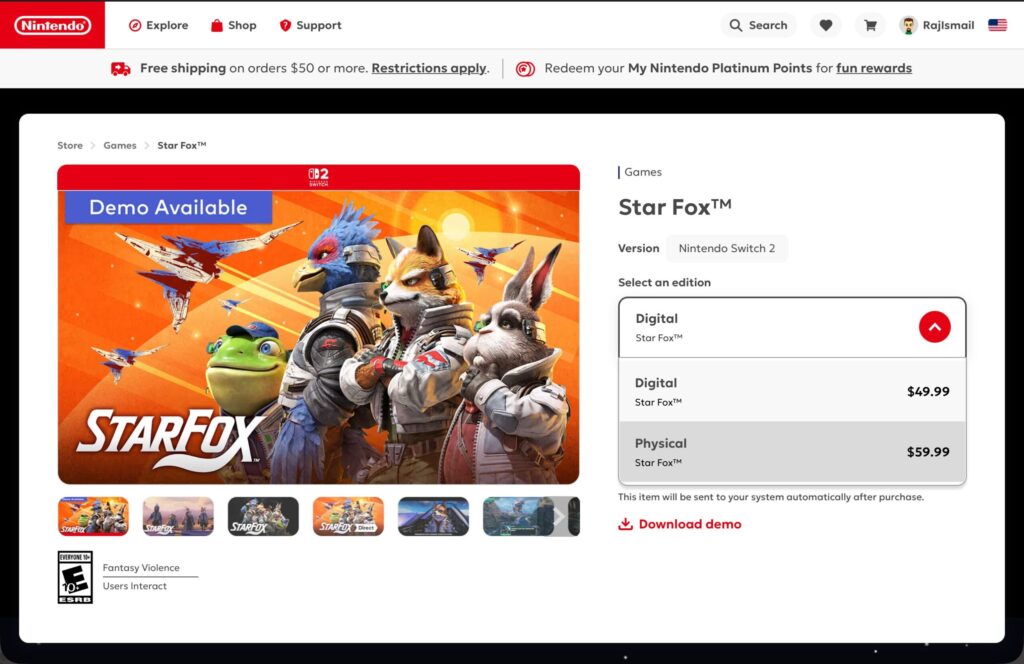
The better comparison is Star Fox. Nintendo describes the new Star Fox on Switch 2 as a cinematic reimagining of Star Fox 64, with enhanced visuals, orchestral music, modern presentation, and new features layered over a familiar foundation. Nintendo’s own website puts the digital version at $49.99 and its physical version at $59.99, which is exactly the pricing lane that suddenly makes the Ocarina of Time listing feel suspiciously loud.
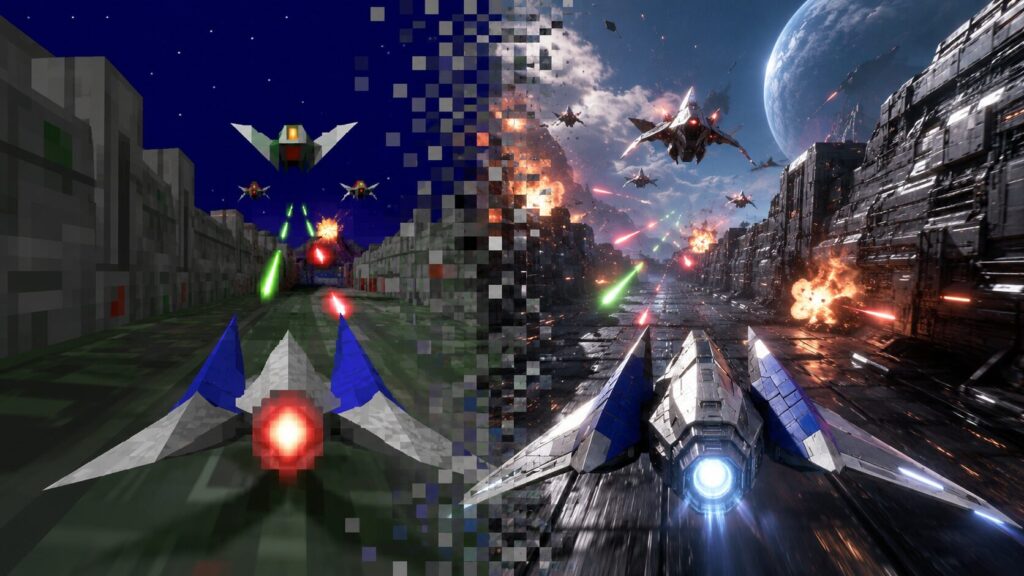
Not that Star Fox looks bad or anything. In fact, it looks like the kind of clean, polished remake a lot of longtime fans would want. Better visuals, better sound, better controls, modern features, and enough nostalgia to make people over thirty suddenly remember the exact sound of Peppy yelling at them. That’s all good stuff. But it’s still, at least from what Nintendo has shown and said, a “reimagining” built around the Star Fox 64 foundation.
If Ocarina of Time is priced exactly like Star Fox, then maybe expecting Star Fox-level updates is more realistic than expecting a full Zelda reinvention. Maybe this isn’t Ocarina of Time rebuilt into a huge modern adventure with expanded maps, reworked dungeons, bigger towns, new systems, and gameplay that feels like it belongs after Breath of the Wild and Tears of the Kingdom. Maybe it’s just Ocarina of Time made prettier, smoother, cleaner, and easier to play in 2026.
That’s not automatically a bad thing. A faithful remake can be great when the original is strong enough to carry it. But pricing matters because Nintendo hasn’t exactly been shy about charging more when it believes a game is bigger, newer, or more expensive to make. In fact they’ve been pretty clear about this. So if Ocarina ends up living in the same pricing neighborhood as Star Fox, it’s hard not to wonder whether Nintendo sees it as the same kind of project.
A Faithful Remake Can Still Be Good
For some people, that should be enough. Honestly, for a lot of people, it will be enough. A beautiful Switch 2 version of Ocarina of Time with modern controls, better lighting, sharper models, improved quality-of-life features, and a proper physical release would be a pretty easy sell to anyone who wants the classic experience cleaned up. Truth be told, for me being such a diehard fan of Zelda, being able to carry all the best versions of the games, including Ocarina for my Switch 2 would be really great.
If you have not played it in years, or if you never played it at all, that version could be magic. There is nothing wrong with a faithful remake when the original is one of the most important games Nintendo ever made. A cleaner, more accessible Ocarina on modern hardware would still matter, especially for younger players who know the name but never really sat down with the game.
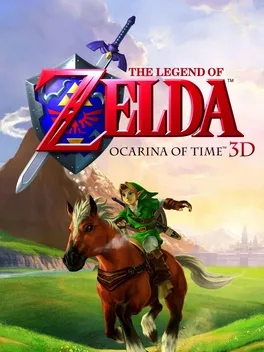
The 3DS remake cleaned up the visuals, improved usability, made inventory management less annoying, helped smooth out some of the rougher edges, and even gave the game stereoscopic 3D. That last part matters more than people may think, because it made Ocarina of Time feel fresh in a way that a basic HD glow-up cannot automatically replace.
The Switch 2 version is certainly not giving us stereoscopic 3D, because the Switch 2 is not a 3DS and Nintendo is not about to ship a cardboard Master Sword periscope to make it happen. So if the new remake does not have 3D, and if it’s not a major gameplay reimagining either, then what is the big hook for returning players?
Most People Just Want to Know If This Will Feel New
The price conversation matters, but not because most people are sitting around trying to solve Nintendo’s retail strategy like it’s a shrine puzzle. Most players care about if this remake is going to feel new enough to matter? That’s where the concern really lives. People are not hoping for Ocarina of Time to come back just so the grass has better lighting and Link’s boots have more stitching. They want to feel that sense of discovery.
That’s hard to do with a faithful remake. It can look beautiful. It can control better. It can make the Water Temple less of a personal attack. But if the game underneath is mostly the same, then for longtime players, it becomes less of a new adventure and more of a very nice memory with a higher resolution. That is still valuable, but it’s not the same thing as feeling like Hyrule has secrets again.
Let’s be honest, the dream version of this remake was never just “Ocarina, but now Link’s tunic has more fabric texture.” The dream version was: what if Nintendo took the story, structure, music, and soul of Ocarina of Time and rebuilt it with modern Zelda ambition? What if Hyrule Field felt vast again? What if Castle Town had real density? What if the dungeons were expanded without losing their identity?
That is a much more exciting idea than “the Water Temple is back, but now the water looks very expensive.” Nobody wants Nintendo to turn Ocarina of Time into a Ubisoft map with 400 icons and a Deku Nut crafting system. But there is a difference between respecting the original and preserving it in amber.
Star Fox-Level Updates Make Sense for Star Fox
That’s why the Star Fox comparison is so useful, even though it’s not perfect. Star Fox 64 is short, arcade-like, score-driven, and built for replay. You can remake that game with better visuals and modern features, and the basic structure still makes sense. Nobody is expecting Fox McCloud to spend 90 hours gathering mushrooms, upgrading his Arwing, and unlocking emotional flashbacks about his father through optional side quests.
Ocarina of Time is different. It’s an adventure game with a world, a timeline, dungeons, side quests, towns, atmosphere, and a sense of discovery that was revolutionary in 1998. Giving that the same pricing signal as Star Fox makes it hard not to wonder if Nintendo’s ambition is smaller than the legend deserves.
That’s the part that stings. The concern is not that $59.99 is too expensive. The concern is that $59.99 might be too telling. It may be Nintendo quietly saying, “Don’t expect a giant new Zelda event here. Expect a very polished remake.” And that would be fine if the secrecy and hype around Ocarina of Time were not carrying the weight of something much bigger.
For Ocarina of Time, a nice remake is not automatically enough. This is one of those games where the name alone creates expectations. People don’t just want to see it again. They want to feel something again. They want to walk into Hyrule and believe, even for a second, that they don’t already know every secret.
Maybe Nintendo Is About to Prove This Concern Wrong
Maybe all of this is unfair. Maybe Nintendo is about to show a trailer that makes this entire concern look silly, and we’ll all be sitting there with our mouths open while Link walks into a completely reimagined Kokiri Forest like it’s the first time again. I would love that. I would happily be wrong here.
There are few gaming moments that would hit harder than realizing Nintendo actually went big with Ocarina of Time and managed to make a familiar world feel mysterious again. If Nintendo can do that at $59.99, then great, I’ll eat my words. Please Nintendo, make me eat my words.
Buy the Games and Gear Mentioned Here
As an Amazon Associate, AsWellToo may earn from qualifying purchases. These links help support the site, future reviews, and the projects we keep building here, at no extra cost to you.
The PS3 Store Was the Warning. The Disc News Was the Bomb
At first, the news sounded like one more sad chapter for older PlayStation fans. Sony is closing the PlayStation Store on PS3 and PS Vita, with PS3 closures beginning in select markets in August 2026 and a broader PS3 and Vita shutdown coming globally in July 2027. Once those stores close, players will no longer be able to buy new content on those systems. Sony says previously purchased games and DLC will remain available for download “for the foreseeable future,” which is one of those phrases that sounds comforting until you think about how much trust it asks from the customer.
That PS3 and Vita news would have been enough on its own. The PS3 has a deep library, a weird architecture, and a long list of games that never moved cleanly to PS4 or PS5. The Vita has an even stranger legacy, full of small games, digital-only releases, niche Japanese titles, and odd little experiments that may never get another fair shot. When a store closes on a system like that, a chunk of gaming history becomes harder to reach, harder to buy, and harder to explain to someone who shows up late.
Then Sony dropped the bomb. Starting in January 2028, Sony will stop producing physical discs for new PlayStation games. New PlayStation releases after that point will be sold through the PlayStation Store and digital retailers instead. Sony says games already released on disc, or already scheduled for disc release before the cutoff, will not be affected. That still leaves the larger message sitting there in plain sight: the future PlayStation library will not need discs.
That is why this story hits harder than another old-store shutdown. Sony showed us the past and the future at the same time. The PS3 and Vita store closures remind us that digital storefronts have lifespans. The disc announcement tells us Sony wants the next era of PlayStation to depend on those storefronts anyway.
Anyone who cares about ownership should feel that in their stomach.
Sony Wants You to Hear “80% Digital” and Stop Thinking
Sony has the perfect number ready. Digital downloads accounted for about 80% of Sony’s full-game PlayStation software sales in fiscal 2025, according to Reuters. That sounds brutal. It makes discs look like a leftover habit, some dusty collector corner that the industry has outgrown. If you stop at that number, Sony’s move sounds obvious. Players chose digital, so Sony followed the market.
That version leaves out the part that matters. Sony’s broad digital number does not tell you what players choose when the same game launches with a real disc and a digital copy at the same time. It blends the whole software market together. That includes major AAA games, but it also includes games that never had a disc option, smaller digital-only titles, PS VR software, bundled software, cheap store clutter, and releases from publishers who could never afford a physical print run in the first place. That is not a clean vote against discs. That is a crowded ballot where half the candidates never showed up.
A small indie studio that launches digital-only did not prove players rejected physical. The studio may not have had the money for manufacturing, distribution, ratings, shipping, retail placement, returns, and unsold inventory. A tiny $3 download does not say anything useful about whether someone wants Spider-Man, Astro Bot, Resident Evil, Final Fantasy, or Assassin’s Creed on disc. Store slop inflates digital totals. Download-only releases inflate digital totals. Small publishers with no physical path inflate digital totals. Then Sony points at the pile and says players moved on.
That is not the full truth. That is the convenient truth.
The Apples-to-Apples Number Breaks the Story Wide Open
The cleaner question is simple: when PlayStation players can buy the same game physically or digitally, what do they choose?
The best public data we have tells a much different story than the 80% headline. The Game Business looked at PS5 games in Europe that were released both physically and digitally, excluding digital-only releases. In that cleaner comparison, 55% of PS5 games sold in Europe were digital in 2023. In 2024, that number rose to 64%. That means physical was still 45% in 2023 and 36% in 2024 when players had both options.
Read that again because it changes the whole argument. Sony’s broad number makes physical sound like a 20% leftover. The cleaner apples-to-apples number shows physical still taking more than a third of sales across comparable PS5 releases in Europe in 2024. One year earlier, physical was almost half.
That is not dead. That is not some tiny niche. That is millions of people choosing the version they can hold, lend, sell, trade, gift, collect, and preserve.
The genre split makes Sony’s broad number look even weaker as a consumer argument. The Game Business reported that single-player, story-driven, family, and prestige games can still lean hard toward physical. In the UK, 45% of Hogwarts Legacy sales were physical, 49% of Assassin’s Creed Mirage sales were physical, and 45% of Resident Evil 4 Remake sales were physical. Spider-Man 2 sold more through physical retailers than digital ones in the UK, with 54% physical, though that includes console bundles. Astro Bot was 55% physical in the UK and nearly 60% physical across Europe.
That is the part Sony would rather bury under the big digital headline. Shooters, sports games, live-service games, and PC-adjacent releases pull digital higher. Helldivers 2 was over 90% digital, according to The Game Business, and games like that shape the overall number. But family games, narrative games, collector-friendly games, and PlayStation-style prestige releases still have a strong physical audience.
Sony is using an investor number to make a consumer argument. Investors want margin, store control, and lower manufacturing costs. Players should ask a different question. If 36%, 45%, 54%, or nearly 60% of buyers still choose physical for certain games, why should Sony be allowed to act like the choice no longer matters?
Digital Did Not Win a Fair Fight
Digital is convenient. I buy digital games too. Most players do. Nobody wants to pretend that swapping discs feels modern when your entire library can sit on an SSD. Convenience has value, and digital delivers it.
The problem comes when companies pretend convenience explains the whole shift. The industry has pushed players toward digital for years. Retail shelf space shrank. Print runs got smaller. Some games skipped discs. Some discs shipped with huge downloads waiting. Some collector’s editions came with codes instead of games. The Xbox Series S launched without a drive. Sony sold a PS5 Digital Edition. Retailers made their game sections smaller. Console stores trained players to pre-order from the dashboard. Publishers gave digital deluxe editions early access, cosmetics, soundtracks, and bonus content that physical buyers often did not get. Then the same industry looked at the results and acted shocked that digital grew.
That is the loop. Make physical less convenient. Make digital the default. Watch physical sales fall. Tell everyone customers chose digital. Remove physical completely.
Players did choose digital in huge numbers. The choice was real for many people. But publishers and platform holders shaped the field. They closed lanes, moved incentives, shrank options, and counted every digital-only release as proof that discs lost.
Sony’s 80% number tells one story. The apples-to-apples numbers tell another. When the disc and the download sit next to each other, a large chunk of PlayStation players still pick the disc.
Sony knows that. Microsoft knows that. Nintendo knows that. Retailers know that. eBay knows that. Collectors know that. Parents who buy used games for their kids know that.
A Disc Is More Than Plastic
A disc is not perfect preservation. Modern physical games can be messy. Some need patches. Some depend on servers. Some include only part of the game. Some are glorified installers. Physical collectors need to be honest about that because pretending every disc is sacred makes the argument weaker.
A real physical release still gives players freedoms that digital does not.
You can sell it. You can lend it. You can trade it. You can give it to your kid. You can bring it to a friend’s house. You can find it years later in a used bin. You can buy it after a license expires. You can discover a game after the publisher has stopped promoting it. You can collect it without trusting one company account to stay alive forever.
Digital games feel owned because they sit in your library. You paid for them. You installed them. You may play them for years. But your access depends on accounts, stores, licenses, servers, platform policies, and the company’s long-term interest in supporting old purchases.
That does not mean digital purchases vanish tomorrow. It means the power sits somewhere else.
The PS3 and Vita store closures prove that storefronts age out. Sony says old purchases will remain available for the foreseeable future, and that is better than cutting people off. But “foreseeable future” is not ownership. It is a promise with no date attached. It asks you to trust that the same company closing the store will keep the download path open for as long as you care about the game.
Collectors have spent years warning about this, and people called them dramatic. Now Sony has closed one door on the past and dated the end of another door in the future.
Xbox May Be Building a Bridge, But It Still Leads to a License
Microsoft sits in a different position. Xbox has pushed digital harder than anyone through Game Pass, Play Anywhere, cloud saves, backward compatibility, and the disc-less Series S. Xbox deserves credit for keeping many older games playable on newer hardware. That matters. Microsoft treated backward compatibility like a feature instead of a museum project, and Xbox players benefited from that work.
The physical Xbox market still feels weak compared with PlayStation and Nintendo. Some releases skip Xbox discs. Some get smaller print runs. Some collectors avoid Xbox versions because they worry about incomplete discs or long-term preservation. Game Pass changed how many Xbox players think about buying games at all.
Now Microsoft may be testing a disc-to-digital feature. According to The Verge, Microsoft has tested a system that lets Xbox owners digitize Xbox One and Xbox Series X discs. The entitlement would tie to the specific disc and Microsoft account, and the digital access would move if the disc moves to another account or player. Original Xbox and Xbox 360 discs are reportedly not part of the test.
That idea sounds much better than leaving physical collectors stranded. If future Xbox hardware drops the disc drive, a disc-to-digital bridge could help players carry parts of their libraries forward. Microsoft may be trying to avoid the harshest version of Sony’s move.
But we should name the tradeoff. A disc-to-digital entitlement turns the disc into proof of access. That may help. It may feel generous compared with a hard cutoff. It may preserve some function for existing libraries. But it still moves ownership closer to the account system. The disc stops being the game and starts acting like a key. That is useful. It is not the same freedom as a disc that works without the platform holder revalidating your access.
Xbox may have the more thoughtful transition plan. Sony has the cleaner break. Both companies point in the same direction.
Nintendo May Be the One to Get Behind, With One Big Warning
Nintendo looks strange in this moment because the company gets so many things wrong and yet may be the last major console maker that still treats physical games as normal. Switch cartridges are small, durable, collectible, family-friendly, and easy to share. Nintendo’s audience still buys boxes. The Game Business reported that new Switch games are still around 80% physical in Europe, which shows Nintendo’s physical audience remains far stronger than PlayStation or Xbox.
That matters. Nintendo still has kids opening game cases on birthdays. It still has parents buying used games. It still has collectors hunting complete cartridges. It still has a platform where physical retail feels central instead of tolerated. So yes, Nintendo may be the platform to get behind if game ownership matters to you.
But there is a warning label big enough to cover the box. Switch 2 Game-Key Cards are not the same thing as full games on cartridge. A Game-Key Card gives you a physical object, but the card acts as a key for a download instead of carrying the full game data. That may still have resale value and some convenience, but it does not preserve the game in the same way a complete cartridge does. Nintendo is not pure. It is testing the same line, only from a better starting position.
Support Nintendo when the full game is on the cartridge. Support publishers that pay for the larger cart. Reward releases that work offline. Skip code-in-box when you can. Treat Game-Key Cards as a compromise, not a victory. Nintendo deserves support only when it protects the thing you care about. A box with a download key inside is digital wearing a costume.
Limited Run, Super Rare, and the Last Physical Lifeboats
This shift makes boutique physical publishers more important. Limited Run Games, Super Rare Games, iam8bit, Fangamer, Strictly Limited, and similar companies exist because digital-only games often need someone else to give them a physical life. They turn downloads into objects. They give collectors something to buy, archive, lend, display, and revisit.
That work matters more if Sony and Microsoft pull away from physical media. A small indie game may never reach a retail shelf. A weird horror game, puzzle platformer, narrative experiment, or retro-style release may never justify a mass-market disc. Boutique publishers can step in and give those games a second chance.
But the standard has to rise now. A boutique physical release only helps preservation if the game is actually there. A collector’s box with a download code does not save a game. A disc that still needs a huge server-side download does not solve much. A cartridge that only unlocks a download leaves future players depending on a storefront that may not exist.
The best boutique publishers need to fight for complete builds, final patches on disc or cart, offline play, clear labeling, and honest packaging. Collectors should reward the companies that do that work. They should call out the ones selling expensive shelf candy with weak preservation value.
Sony’s decision may push more boutique energy toward Nintendo, PC collector editions, retro reissues, soundtrack sets, art books, and specialty releases. PlayStation physical collecting may become more time-sensitive. If Sony stops new discs in 2028, every remaining PS4 and PS5 disc becomes part of a closed era. That sounds dramatic because the change is dramatic.
eBay and Used Games Are About to Matter More
The used game market is not just bargain hunting. It gives games a second life. eBay, GameStop, local retro stores, Facebook Marketplace, conventions, flea markets, and trading groups all depend on physical games moving from one person to another. A game can flop at launch and find an audience later. A kid can discover a PS3 game because someone sold it for ten bucks. A collector can rebuild a childhood library. A YouTuber can revive interest in something the publisher forgot. A parent can buy three used games instead of one new download.
Digital-only breaks that chain. There is no used digital copy. There is no resale value. There is no lending. There is no trade-in credit. There is no local shop discovery. There is no box that survives the account. The platform controls the price, the discount schedule, and the availability. That control helps companies. It hurts players.
If PlayStation discs end in 2028, the existing market changes overnight. PS3 games trapped on original hardware move higher on the priority list. Vita games get scarier. PS4 and PS5 complete editions become more important. Low-print games, delisted games, licensed games, final-patch discs, and titles with no modern ports may jump as collectors realize the PlayStation disc era now has an endpoint.
That does not mean panic-buy everything. It means buy with intent. Make a list. Start with games you care about, games that never got ported, games with expired licenses, games with strong single-player content, and games where the disc matters.
The late collectors will pay more. The early collectors will look smarter. The people who mocked physical media will end up searching eBay after the storefront closes.
Preservation Is the Culture Surviving the Business Model
Preservation does not mean refusing the future. It means games should survive the business model that sold them. Companies move on. Stores close. Licenses expire. Servers shut down. Payment systems age. Rights holders change. Music licenses disappear. Developers close. Publishers merge. Hardware breaks. Accounts get lost. Passwords vanish. A digital-only future asks players to trust that all of those things will work out.
Physical media does not solve every problem, but it gives players, collectors, libraries, archives, and families something to hold. It gives the game a chance to exist outside the storefront.
That matters most for the odd games. The forgotten games. The games that did not sell well enough to get a remaster. The games with licensed music. The games built for strange hardware. The PS3 games stuck on PS3. The Vita games nobody noticed until years later. The small games that never had marketing but deserved a shelf. A culture loses something when the only path to a game runs through an account screen.
Sony’s move exposes the bargain the industry wants players to accept. You get convenience. They get control. You get instant access. They get the end of resale. You get a cleaner dashboard. They get the power to decide what remains available. That may sound fine until the game you care about sits on the wrong side of a closed store.
The Recommendation
Nintendo is the best major console ecosystem to support right now if physical ownership matters to you, but only when the game is actually on the cartridge. Full carts deserve support. Game-Key Cards deserve caution. Code-in-box releases deserve rejection whenever a better option exists.
PlayStation collectors should move now with purpose. PS3 and Vita games need attention first because those stores have dated closures and many games remain trapped on old hardware. PS4 and PS5 physical libraries also matter more now because Sony has put an endpoint on new PlayStation discs. Buy the games you care about before the market fully absorbs what this means.
Xbox owners should watch Microsoft’s disc-to-digital plan, if it becomes real. It may help preserve access to parts of your library, and Microsoft deserves credit if it builds a consumer-friendly bridge. Still, do not confuse a digital entitlement with ownership. Useful access is not the same as a game you can hold, lend, resell, and preserve without permission.
Support Limited Run, Super Rare, iam8bit, Fangamer, Strictly Limited, and other boutique publishers when they do the hard version of physical publishing. Complete builds. Honest packaging. Offline play. Real media. Skip the expensive boxes that give you a code and call it preservation.
The larger recommendation is simpler. Stop letting companies use blended digital numbers to convince you that ownership is already dead. The apples-to-apples data shows a different picture. When players have a real choice, a huge number still choose physical. Sony knows that. The industry knows that. Now players need to know it too.
PlayStation just killed game discs. Maybe not the discs already on your shelf. Maybe not the games already scheduled before 2028. But Sony has marked the future of PlayStation physical media, and the PS3 and Vita store closures show what happens when the future becomes old enough for a company to stop caring.
The disc was never just plastic. It was your right to buy a game once and let it live somewhere other than a corporate account system.
That right is now on the clock.
Buy the Games and Gear Mentioned Here
As an Amazon Associate, AsWellToo may earn from qualifying purchases. These links help support the site, future reviews, and the projects we keep building here, at no extra cost to you.
Playing the Switch 2 for a year has been weird, because it’s not one of those systems I just respect from a distance. It’s not sitting there like some expensive piece of tech I’m supposed to admire when I have time. It’s in my backpack, charged, case having taken a beating from real use, and ready to save me from the part of the day where New York tries to drain the life out of schmucks like me.
I’ve got about 90 minutes each way on my commute. That’s not a cute little ride. That’s real time, and I’m not giving all of it away to TikTok, Insta, bad 5G, and whatever nonsense happened on the train that morning….And god damn if someone spills their friggin coffee on the seat next to me one more time. What the hell is wrong with you people with the paper cups of coffee. Invest in a friggin Yeti Rambler you jamoke….stay calm….serenity now….If I’m not working, blogging, planning something for AsWellToo, or thinking through DynoCalc ideas, there’s a pretty good chance I’m on the Switch 2.
That’s why the system matters to me. It’s not just because it’s more powerful, even though that obviously helps. It’s because the extra power makes the whole idea work better. The games load faster, feel smoother, look sharper, and in docked mode, they can actually hold up on the TV instead of feeling like you’re blowing up a handheld image and hoping nobody notices.
The Switch 2 Makes Portable Gaming Feel Less Like a Tradeoff
The whole promise of the Switch was always simple. Take your games anywhere. Great idea. Genius idea, honestly. But the problem with portable gaming is that “portable” can turn into “yeah, but” real fast.
Yeah, but the frame rate gets rough. Yeah, but the screen makes everything look cramped. Yeah, but the docked version doesn’t look great on the big TV. Yeah, but the big games feel like they’re running with one shoe tied. That’s the kind of stuff that doesn’t matter in a trailer, but it matters when you’re tired, commuting, and trying to squeeze real gaming into the cracks of a normal adult day.
The Switch 2 cuts down on those “yeah, but” moments. It doesn’t make every game magically perfect, but it makes a lot more games feel like they belong in your hands. That’s the difference. I don’t want to spend my commute babysitting a compromised version of a game. I want to play, make progress, and feel like the time counted.
GTA Trilogy Finally Makes Sense as a Commute Game
Cover art via Rockstar
The Grand Theft Auto Trilogy has had a messy history, and I’m not going to sit here and pretend it launched like some perfect museum-quality collection. Everybody knows that release had baggage. But on Switch 2, it becomes something different for me, because the smoother performance makes it easier to just fall into those worlds instead of constantly noticing the seams.
GTA needs flow. Driving through Vice City, whipping around corners, getting into trouble, messing up a mission, restarting, getting distracted by the radio, and then doing the mission anyway is the whole rhythm. When the game feels smoother and steadier, the rhythm works better. It’s not about pretending these games are new. It’s about making them easier to live with now.
Vice City especially hits because that game has a mood. The colors, the music, the fake-Miami heat, the whole early-2000s chaos of it all still works. On Switch 2, I can jump in for one mission, or just drive around until the train gets where it’s going. That’s when a game becomes dangerous, because it stops being something I plan to play later and turns into something I actually play.
Assassin’s Creed Shadows Fits My Real Gaming Life
Now before you all roast me for buying a game key card, hear me out. This one is an exception.
Assassin’s Creed Shadows is one of the big reasons the Switch 2 feels like it’s playing in a different league. This is the kind of game I used to automatically think of as a PlayStation game first. I’d play it at home, chase trophies, maybe put 120 hours into it, and then portable play would be some separate thing that didn’t really count.
That’s not how I want to play anymore. I still care about trophies on PS5, and I still want that big-screen PlayStation version when I’m home. But I also don’t want my commute to be dead time. With cross-progression, I can grind, explore, clear side content, and keep the story moving on Switch 2, then jump back into PS5 later where the trophies automatically pop and the full living-room experience is ready and waiting.
That only works if the game feels good enough to play in handheld mode, and that’s where the Switch 2 makes the difference. Assassin’s Creed is all movement and decision-making. You’re climbing, sneaking, tracking enemies, fighting, running away because you got cocky, and then pretending that was the plan all along. When the controls feel responsive and the world holds together better, it stops feeling like a novelty and starts feeling like a real way to play.
Do I wish this was a complete game on cart? Of course I do. But the trophies bro! This one let’s me virtually take my PS5 game with me on my commute.
Black Flag Still Has That “One More Thing” Problem
Cover art via Ubisoft
Assassin’s Creed IV: Black Flag is one of those games that lies to you. You tell yourself you’re going to play for 15 minutes. You’ll just sail a little, maybe clear one objective, maybe grab one collectible. Then an hour disappears because you saw a ship, then a treasure map, then an island, then another ship, and now you’re somehow deep into pirate errands like you don’t have anything else going on.
That’s why it works so well on Switch 2. Black Flag is all about movement and atmosphere. Sailing needs to feel smooth. Climbing needs to feel clean. The camera needs to keep up. The world needs to look sharp enough that the ocean still feels like an ocean and not a blurry blue sheet with boats on it.
In handheld mode, it becomes one of the best commute games because you can make progress in short bursts. Docked, it still has that big adventure feel, especially when the image is sharper on the TV. It’s almost like the Switch 2 reminds you why this game was special in the first place, then makes it easier to keep playing today.
Mario Kart Is Still Built for the Room
Cover art via Nintendo
Mario Kart World and Mario Kart 8 Deluxe both belong on my Switch 2, and I know that sounds like too much Mario Kart, but it really isn’t. Mario Kart doesn’t work like normal games. You don’t finish it, uninstall it, and move on with your life. Mario Kart lives in the house.
Mario Kart 8 Deluxe is still the safe bet because everybody knows it. Family comes over, controllers come out, and nobody needs a lesson. That’s where docked mode and 4K output matter. This is a room game. People are watching the TV, yelling about items, blaming the game, blaming each other, and acting like the blue shell was a personal attack. The cleaner image and smoother feel make that whole family-room experience better.
Mario Kart World is the fresh chaos. It’s the one that makes the Switch 2 feel like it has its own lane instead of just being the stronger machine that plays older games better. Having both on the system makes sense to me because one is comfort food and one is the new toy. Depending on the night, either one can take over the TV.
Donkey Kong Bananza Feels Like Nintendo Showing Off
Cover art via Nintendo
Donkey Kong Bananza is the kind of game that explains the hardware upgrade without needing a chart. You don’t need somebody to point at numbers and tell you why it matters. You feel it when the game starts moving. It’s big, colorful, physical, and built around smashing through the world like Donkey Kong finally got room to stretch.
That kind of game needs responsiveness. If you’re breaking stuff, punching through environments, reacting to movement, and bouncing from one idea to the next, the system can’t feel like it’s dragging behind you. On Switch 2, the action has more snap, the world feels cleaner, and the destruction feels like it’s part of the fun instead of something the hardware is barely surviving.
Docked mode gives it that showpiece quality. It’s the kind of game you put on the TV and immediately understand why Nintendo still gets away with being Nintendo. Handheld mode is perfect for the commute because it doesn’t ask for some deep emotional preparation. You turn it on, smash stuff, move fast, and your brain wakes up a little.
Zelda at 60 FPS Is the Upgrade That Sells Itself
Cover art via Nintendo
Breath of the Wild and Tears of the Kingdom at 60 FPS are almost unfair. These games were already huge, but it’s almost like the Switch 2 gives them a second life. Not in some dramatic marketing way. I mean in the simple way that movement feels better, and when movement feels better in Zelda, everything feels better.
Breath of the Wild is all about quiet exploration. Climbing a mountain, gliding across a valley, riding through a field, spotting something weird in the distance, and deciding to ignore your actual objective because that thing over there looks interesting. When that all runs smoother, the whole world feels easier to sink into. The game gets out of your way more often.
Tears of the Kingdom benefits even more because that game has so much going on that it still feels impossible. The building, flying, physics, sky islands, depths, caves, and ridiculous player inventions all feel better when the frame rate is smoother. It’s almost like the game can finally stretch its legs the way it always wanted to.
Indie Puzzle Platformers Are My Brain Food
This is where the Switch 2 hits my personal taste the hardest. I love indie puzzle platformers. Inside, Limbo, Planet of Lana, Gris, Ori, Little Nightmares, Animal Well, and all those strange little games that make you slow down, look around, notice patterns, and actually think for a minute. That’s my lane.
Animal Well is a perfect example because it’s not trying to impress you with size. It’s not screaming at you. It’s not throwing a giant cutscene in your face every five minutes. It’s quiet, weird, tense, clever, and full of those little moments where your brain finally connects two things and you feel like a genius for about eight seconds.
On Switch 2, those games benefit from polish in a way people might overlook. A cleaner screen matters. Smoother movement matters. Better responsiveness matters. In a puzzle platformer, one jump, one timing window, one visual clue, or one tiny detail can change the whole experience. When the system makes that feel better, the game gets better too.
Playing Is Better Than Turning Into Commute Mush
I’m not a doctor, and I’m not going to pretend the Switch 2 is a medical device. But I do believe there’s value in keeping your brain active, curious, flexible, and challenged. Especially when the alternative is letting your attention span get mugged by TikTok for three hours a day.
Games ask something from you. Mario Kart works reaction time. Zelda works spatial thinking. Puzzle platformers work observation and logic. Assassin’s Creed and GTA work memory, navigation, planning, and improvisation. Even when I’m just playing to relax, my brain is still doing something.
That matters to me. I don’t want the commute to just be this dead zone where my mind gets softer every day. I’d rather write, read, plan, or play something that makes me react and think with my hands. That feels like a better use of the time, and honestly, it makes the ride feel less like the city won.
Now Give Me Stellar Blade Physical
The Switch 2 game I keep thinking about is Stellar Blade. I want that game portable badly, but I want it done right. And for me, “done right” means a proper physical version.
Not a code-in-a-box. Not a fake physical release where the case is basically decorative. I mean a real physical copy that belongs on the shelf. I still care about that. I like owning the thing, collecting it, preserving it, lending it, and knowing the version I bought isn’t just a tile on a digital storefront.
Switch 2 has already shown it can make bigger games feel realistic on a portable system. Now the physical side has to keep up. If Stellar Blade gets a real Switch 2 physical release, that’s probably an instant buy for me.
The Honest Problem Is That I Want More
The only real problem with the Switch 2 one year later is that now I’m greedy. Once you get used to smoother performance, sharper visuals, better handheld play, and stronger docked output, you start looking at every game and thinking, “Okay, where’s the Switch 2 version?”
That’s a good problem, but it’s still a problem. I want more upgrades. I want more physical releases. I want more big games with cross-progression. I want more indie games that take advantage of the cleaner screen and smoother feel. I want publishers to stop treating portable players like we’re asking for the impossible.
And yeah, I want Nintendo to keep pushing too. Don’t just give me power and then play it safe. Give me weird stuff. Give me polished stuff. Give me games that feel good in the hands first, because that’s the thing Nintendo still understands better than almost anybody.
One Year Later, This Thing Fits My Life
One year later, the Switch 2 has earned its spot because it fits the way I actually live. I don’t always have a quiet room, a free night, and two hours to disappear into a game. What I do have is a long commute, a backpack, a backlog, a family room, and a brain that still wants to stay sharp.
That’s the real win. Switch 2 didn’t replace my PS5, my Xbox, or my love of physical media. It filled the gaps between them. It gave me a way to play big games, small games, family games, weird games, old favorites, and new obsessions in places where gaming used to disappear.
So yeah, one year later, this thing works. It turns a train ride into Hyrule, a delay into Vice City, a family night into Mario Kart chaos, and a tired ride home into one more chance to actually play. That’s not just better hardware. That’s a console that understands the way I game now.
Buy the Games and Gear Mentioned Here
As an Amazon Associate, AsWellToo may earn from qualifying purchases. These links help support the site, future reviews, and the projects we keep building here, at no extra cost to you.
Grand Theft Auto VI should have been an easy celebration. After more than a decade of waiting, Rockstar finally put real numbers and real details on the table: $79.99 for the Standard Edition, $99.99 for the Ultimate Edition, pre-orders opening ahead of launch, and a November 19, 2026 release date for PlayStation 5 and Xbox Series X|S.
And honestly, the game looks ridiculous in the best way. Vice City looks alive, dangerous, funny, expensive, soaked in neon, and built with the kind of obsessive detail only Rockstar can pull off when it decides to disappear for years and come back with a cultural earthquake. The problem is that buried under all the hype is a detail that should make every physical games fan stop cold.
The boxed version of GTA 6 is not really physical. It is a box with a download code inside, which Jordan over at Physical Paradise has perfectly called “code-in-a-box bullshit.” That phrase is funny because it’s blunt, but it’s also frustrating because this is not some tiny side release from a publisher testing the waters. This is Grand Theft Auto, and when GTA does something, the rest of the industry pays attention.
This Is Not Really Physical
Screenshot via Rockstar Games
Rockstar can call it a physical version, retailers can put it on shelves, and collectors can still line it up next to the rest of the series. But if there is no disc inside the box, then the box is not the game. The box is packaging for a license.
That distinction matters more than some people want to admit. A disc is something you can lend, sell, trade, collect, preserve, and pull off a shelf years later. A code is something you redeem once, lock to an account, and then hope remains accessible through the platform, the storefront, the servers, and whatever terms of service exists in the future.
This is the part that stings with GTA specifically. Grand Theft Auto has always been one of those series people shared, borrowed, traded, and passed around. Someone borrowed GTA III. Someone passed around Vice City. Someone sold San Andreas to a friend. Someone picked up GTA IV used. Someone bought GTA V on disc, brought it to another console, or traded it in later.
With GTA 6, if the box only gives you a one-time code, that old chain breaks. You can still buy something that looks physical, but it no longer behaves like a physical game. There are rumors of a physical coming down the road, but we’ll just have to wait and see.
The Old GTAs Were Games You Could Hand to Someone
There is something simple and powerful about handing a game to another person. No account sharing, no console-family setup, no digital license weirdness, and no explaining which profile owns what. You just hand over the disc, and the other person plays the game.
That was always one of the quiet strengths of physical media. It made games social in a way digital storefronts still have not replaced. A game could move from one living room to another, survive a console being sold, or sit in a collection for years and still mean something because the game was actually on the media.
GTA 6 being “physical” without a disc cuts directly against that history. It is not just a collector complaint. It is a sharing problem, a resale problem, a preservation problem, and a consumer-rights problem.
That’s why this feels bigger than one box. If the biggest game in the world can show up at retail without a disc and everyone shrugs, then every other publisher gets the message. They will not see outrage. They will see permission.
The Pre-Order Bonus Is Pure Vice City Nostalgia Bait
Screenshot via Rockstar Games
The Vintage Vice City Pack is exactly what Rockstar knows will make longtime fans pause. It is not just a random skin bundle. It is built around the memory of the neon era, the palm-tree fantasy, the white suits, the pink glow, the oceanfront excess, and the feeling that Vice City was never just a place. It was a vibe.
The pack in
cludes the ’55 Vapid Stanier, a Shore Court garage near Ocean Beach, decadent outfits and hairstyles for Jason and Lucia, and a weapon pattern that leans directly into the old-school Vice City fantasy. The whole thing is designed to make players feel like they are stepping back into that Tommy Vercetti-adjacent world without actually saying that is what they are doing.
It is smart, stylish, and very obviously engineered to hit the nostalgia button as hard as possible. Rockstar knows exactly what it is doing when it shows Jason in that pastel, flowered Vice City look and Lucia dressed like she walked out of a neon-soaked crime fantasy. It is not just bonus content. It is a memory trap.
And honestly, this is the kind of bonus I have the least problem with. A throwback car, a flashy outfit, a hairstyle, a garage, and a tropical weapon pattern are not automatically evil. If somebody wants to pre-order because they want Lucia in the red dress, Jason in the pastel suit, and a classic sedan parked near Ocean Beach, I get it.
GTA has always been about style as much as crime. Vice City nostalgia is probably one of the easiest sells Rockstar has because it is not just selling a car or a shirt. It is selling the feeling of being back where the neon burned brightest.
The Ultimate Edition Might Actually Be Worth the Extra $20
Screenshot via Rockstar Games
Here is where the article has to be fair: the Ultimate Edition does not look like some lazy skin bundle. For $20 more than the standard version, Rockstar is throwing in a pretty wide spread of vehicles, weapons, apparel, shops, garages, story-threaded bonuses, and chapter-based unlocks for Jason and Lucia. I still hate the code-in-a-box problem with the so-called physical version, but I cannot look at this Ultimate Edition package and pretend there is nothing here.
The big thing is variety. This is not just one gold gun and a t-shirt. The Ultimate Edition includes Vice City-style outfits, tattoos, hairstyles, personalized weapons, exclusive vehicles, mod shop access, clothing store access, a tattoo shop, a salon, garages, special missions, and vehicles tied to Jason’s safehouse.
That is a lot of lifestyle content for a game where lifestyle is basically half the fantasy. GTA is not only about missions, robberies, shootouts, and driving too fast through traffic. It is also about what you wear, what you drive, where you park it, what your character looks like, and whether your version of the world feels like yours.
Some of it sounds genuinely cool. The Classic Car Collection special commission has players tracking down abandoned classic cars and restoring them. The PTT Youngins illegal goods store sounds like a raid-based reward setup with special items and contraband. The One-Eyed Willie’s mod shop is focused on off-road modifications and hand-painted automotive art, while Rideout Customs leans into flashy interiors, rims, and donk styling.
That is not nothing. For GTA players who care about cars, garages, customization, and looking ridiculous in the best possible way, this is exactly the kind of stuff that can make the world feel more personal. It is not just a menu full of extras. It sounds like Rockstar is building little pockets of flavor into the world itself.
The vehicle list also has some real personality. The ’67 Vapid Dominator Buggy looks like mud-slinging chaos for the backwoods, the Shitzu Squalo gives players a pink-and-blue watercraft with a weapons crate, and the ’95 Grotti Cheetah is pure Vice City nostalgia with a retro-futuristic Shore Drive look. Then there are Jason’s safehouse vehicles, including a Dinka Enduro motorcycle and a Crest Kayak, which is the kind of little world-building detail that makes GTA feel lived in before you even start causing trouble.
The fashion side is just as aggressive. Stock 305 gives Jason and Lucia exclusive streetwear, Sara’s Unisex Salon offers hairstyles, facial hair, makeup, and nails, and Electric Fang Tattoo brings more than 50 signature tattoos. Add in personalized pistols for both characters, Hawk & Little Morgan revolvers, classic Vice City styling, the Goodtime Gear capsule collection, and suddenly the Ultimate Edition starts to feel less like a bonus pack and more like a full lifestyle layer sitting on top of the base game.
The Whales Are the Target, But That Does Not Make It Bad
Let’s be honest about who this is for. The Ultimate Edition is absolutely aimed at the whales, the collectors, the day-one obsessives, the car-customization addicts, the fashion players, the GTA Online crowd, and the fans who want to squeeze every ounce of style out of Leonida from the second the game unlocks.
And that is not automatically a bad thing. If someone wants to spend the extra $20 to get more cars, more clothes, more tattoos, more garages, more weapon variants, and more ways to make Jason and Lucia feel like their version of Jason and Lucia, that sounds like a fair deal. It is their money, right?
The line is gameplay advantage. If this stuff stays cosmetic, customization-based, side-content focused, or flavor-driven, then I am not mad at it. Let the whales whale, let Rockstar sell the deluxe fantasy, and let everyone else decide whether the extras are worth the money.
The danger is when the shiny thing slowly becomes the missing thing. If a premium edition locks off meaningful stores, missions, mechanics, or advantages that make the standard edition feel second-class, then we have a problem. Based on what Rockstar is showing, though, this looks more like a loaded collector-style upgrade than a pay-to-win trap.
That is why the GTA 6 conversation is so weird. The Ultimate Edition might actually be worth the money, while the physical release might be one of the most disappointing physical-media moves Rockstar has ever made. Those two things can both be true at the same time.
The Game Can Look Amazing and Still Be a Problem
This is the annoying part because GTA 6 really does look amazing. Vice City looks alive in a way that feels almost unfair to every other open-world game. The characters, the lighting, the streets, the cars, the density, the chaos, and the scale all look like Rockstar has been quietly building a monster while the rest of the industry tried to guess what was coming.
It is possible to be excited about that and still call out the physical edition problem. Those two things do not cancel each other out. GTA 6 can be one of the most impressive games ever made and still be a depressing milestone for people who care about actually owning games.
In fact, that is why this matters so much. If a small game ships as code in a box, people complain for a day and move on. If GTA 6 does it and still sells tens of millions of copies, every publisher in the industry gets the message.
Physical collectors are not asking for magic. We know modern games often need patches. We know file sizes are huge. We know online modes change. We know day-one updates exist. But there is still a massive difference between a disc that contains a playable build and a box that contains a single-use code.
This Could Be the Moment the Industry Was Waiting For
Publishers have wanted to weaken used games for years. Digital storefronts made that easier. Subscriptions made it easier. Online accounts made it easier. Massive file sizes made it easier. Now GTA 6 might make it feel normal.
That is the scary part. This is not just about one game. This is about the biggest game in the world walking into retail with a box that cannot be shared like a disc, cannot be resold like a disc, and cannot be preserved like a disc.
If consumers shrug, the industry will notice. If retailers stock it like a normal physical release, the industry will notice. If the game breaks records anyway, the industry will definitely notice.
And to be clear, GTA 6 probably will break records. It probably will dominate the year. It may even deserve every ounce of hype it gets. But if this is really the moment where a mainline GTA stops being sharable on physical media, that deserves to be part of the story too.
Buy the Games and Gear Mentioned Here
As an Amazon Associate, AsWellToo may earn from qualifying purchases. These links help support the site, future reviews, and the projects we keep building here, at no extra cost to you.
Nobody warns you that one day your child will stop talking about what they want to be and start talking about where they want to become it. As parents, we spend years encouraging our kids to dream big. We tell them they can become anything if they’re willing to work hard enough. We cheer them on through school plays, science fairs, concerts, sporting events, competitions, auditions, and every little milestone that slowly shapes who they’re becoming. Somewhere along the way, those childhood dreams stop feeling imaginary and start becoming real conversations about real schools, real careers, and very real futures.
For me, that moment came with my daughter, Alyssa. Like every proud parent, I wanted to encourage her to chase the biggest dream she could imagine. I also wanted to protect her from making a decision that could follow her financially for decades. It didn’t take long before those two goals started pulling in opposite directions, and I suddenly found myself asking questions I never expected to ask.
One evening I sat down at my computer thinking I was simply going to estimate what college might cost. Tuition was easy enough to find. Housing wasn’t much harder. Then came meal plans, books, travel, technology, fees, supplies, and dozens of expenses that quietly pile on until you stop adding because you almost don’t want to know the answer anymore. When the calculator finally stopped, the number staring back at me was somewhere around $370,000.
The number was shocking, but it wasn’t the thing that kept me awake. What kept me awake was realizing I had absolutely no idea whether that number represented an incredible investment or an avoidable mistake. Every time I thought I had an answer, another question immediately appeared. Would scholarships make enough difference to change everything? Would financial aid dramatically reduce the cost? Would another school provide nearly the same opportunity for much less money? Would borrowing today quietly shape my daughter’s life ten years from now in ways we couldn’t yet imagine? The worst part wasn’t feeling overwhelmed. The worst part was feeling alone.
The Part Nobody Talks About
Nobody prepares parents for this. One day you’re helping your child choose classes in high school. The next day you’re drowning in conversations about FAFSA, grants, merit aid, subsidized loans, unsubsidized loans, expected family contributions, net price calculators, interest rates, repayment plans, and enough financial terminology to make you wonder whether everybody else secretly attended a class you somehow missed.
What surprised me wasn’t how complicated it all was. What surprised me was how quickly I started questioning myself. I began wondering whether everyone else understood this process and I was simply the one falling behind. Every website assumed I already knew the language. Every calculator expected me to understand where its numbers came from. Every article seemed to skip straight to the answer without explaining why the answer mattered.
Nobody likes feeling dumb, especially when they’re trying to make one of the biggest decisions of their family’s life. I wasn’t looking for someone to make the decision for me. I just wanted someone to walk beside me and explain what each step actually meant before asking me to take the next one. Looking back, I don’t think I was the exception. I think I was the rule.
The Night Everything Changed
Like most people, I started hunting for calculators. I found calculators for financial aid, calculators for student loans, calculators for scholarships, calculators for repayment, calculators for salaries, calculators for retirement, and calculators for just about every financial decision you could imagine. Every one of them answered a question, but none of them answered my question.
The more I used them, the more frustrated I became because every calculator acted like it was the only calculator that mattered. I’d estimate financial aid in one place, manually type those numbers into another tool, compare schools somewhere else, then realize I needed to start over because I wanted to see what happened if one scholarship changed or one assumption turned out to be wrong. Instead of gaining confidence, I felt like I was juggling dozens of disconnected puzzle pieces that refused to fit together.
That’s when I finally understood what had been bothering me all along. I wasn’t looking for another calculator.I was looking for someone to help me through the journey.
The Jurassic Connection
At some point, I started calling the idea a “Field Pack,” and I know exactly how ridiculous that sounds. It immediately makes people think of Jurassic Park. Somebody hands you a backpack, a flashlight, a radio, a map, and maybe one nervous guide who definitely isn’t making it to the third act. Then they point toward the jungle and wish you luck. It’s funny until you realize that’s almost exactly what college planning feels like.
Every path looks important. Every decision feels expensive. Every turn raises another question. You’re carrying something more valuable than anything else in your life, and you’re terrified of making the wrong decision because you don’t know what’s waiting around the next corner. The people around you keep speaking in acronyms, everyone else appears to know where they’re going, and you’re quietly hoping nobody notices you’re just trying to keep up.
That’s why the name never changed. These aren’t just collections of calculators. They’re survival packs. More importantly, they’re a reminder that you don’t have to walk into that jungle alone.
A Guide Instead of a Spreadsheet
That realization became the foundation for the College Parent Field Pack and the College Student Field Pack. I stopped thinking about individual calculators and started thinking about conversations. What question does a parent ask first? What naturally comes next? What information should carry forward so nobody has to type the same numbers over and over again? What explanation would have helped me when I first started this journey?
The Parent Field Pack begins with understanding financial aid because that’s where so many families begin asking questions. From there it naturally flows into understanding actual college costs instead of brochure prices, then explores scholarships, borrowing, long-term repayment, return on investment, and finally compares different schools side by side. Every step builds on the one before it because that’s how real decisions work. You’re not solving isolated math problems. You’re slowly building confidence that you’re seeing the whole picture.
The Student Field Pack follows a different path because students are asking different questions. They’re wondering what dorm life really costs, whether a meal plan makes sense, what a first paycheck feels like after taxes, how long student loans might follow them, and what happens after graduation. Those questions deserve thoughtful explanations too, because understanding life after college often changes how someone thinks about college itself.
Follow the Journey or Jump Right In
One of the biggest goals I had while building these tools was making sure people never felt trapped. Some parents will want to follow the entire guided journey from beginning to end, letting each calculator pass information to the next so they don’t have to keep re-entering the same details. That’s exactly how I designed it because that’s exactly what I wished existed when I started this process.
Other people already know what they’re looking for. Maybe they’re sitting on the couch watching the latest episode of Strange New Worlds Season 4 and suddenly wonder what another $10,000 scholarship would do to the overall plan. Maybe they’re watching the trailer for GTA 6 and their mind drifts back to college, wondering whether another school might produce nearly the same future with far less debt. That’s how my brain works. I revisit ideas constantly, test scenarios, and ask “what if?” far more often than I probably should.
The Field Packs support that too. You can jump directly into any calculator or simulator, change a single assumption, and immediately explore a different path. The journey is there when you want guidance, but it never gets in your way when you simply want to answer one important question.
If You’re Feeling What I Felt…
I built these Field Packs because I never wanted another parent to feel the way I felt staring at that $370,000 estimate. Not because the number was frightening. Because I felt like I was carrying it by myself.
Nobody should feel embarrassed for asking questions. Nobody should feel like they’re behind because they don’t understand financial aid terminology. Nobody should feel like they need a degree in finance before they can help their child pursue a dream. This process is complicated enough without making parents feel like they’re failing some invisible test.
My daughter still has the same dream she had before I opened that spreadsheet. The dream didn’t get smaller because the number got bigger. What changed was that I finally stopped feeling like I was wandering through unfamiliar territory without a map.
If you’re sitting at your own kitchen table tonight with tuition estimates scattered across the screen, wondering whether you’re making the right decisions for someone you love, I want you to hear something I wish somebody had told me months ago. You’re not behind. You’re not bad at this. You’re certainly not alone. And if these Field Packs can make you feel even a little more confident, a little more informed, and a little less isolated than I felt that night, then every hour I spent building them was worth it.
Want To Try It?
All of the calculators including the ones mentioned in this article are free at DynoCalc.com
The World Cup is easy to enjoy until the group stage gets weird. Your team wins one match, draws another, someone else loses by two, another team scores late, and suddenly everybody is asking the same question: “Wait, what do we actually need to advance?”
That’s where DynoCalc’s new World Cup Calculator starts to make sense. It’s built for the part of the tournament where the table gets tight, the goal difference starts to matter, and every match turns into a math problem. Fans love the drama, but nobody wants to sit there with a notepad trying to figure out whether a draw is enough or whether one more goal changes the whole path.
The Group Stage Gets Messy Fast
The World Cup group stage looks simple at first. Teams play, they earn points, and the best teams move on. But once you get into the second and third matches, things can get confusing quickly. A team may have four points and still not feel safe. Another team may have three points and still be alive. A draw in one match can completely change what another team needs later that night.
That’s the exact kind of real-life math DynoCalc was made for. The World Cup Calculator helps turn that chaos into something easier to understand. Instead of guessing what the table means, you can start thinking through scenarios in a cleaner way.
Built for the “What Happens If?” Moment
The most useful part of a World Cup calculator is not just showing what already happened. Any sports site can show a table. The better question is what happens next. What if your team wins by one? What if they draw? What if the other match ends 2-0? What if goal difference becomes the tie-breaker?
That’s where this tool fits. It’s meant for fans who want to understand the moving pieces without needing to become tournament-rule experts. You can follow the standings, think through possible results, and get a better feel for what each team needs. That makes the final group matches more fun because you actually understand the stakes while they’re happening.
It’s for Casual Fans Too
Not everyone watching the World Cup follows soccer all year. Some people only show up for the big tournament, and that’s totally fine. The World Cup is one of those rare events where casual fans, serious fans, families, friends, and entire countries all end up watching the same thing at the same time.
But that also means a lot of people need a simple explanation. They don’t want a complicated spreadsheet. They don’t want to read ten pages of rules. They just want to know whether their team is safe, in trouble, or praying for help from another match. DynoCalc’s World Cup Calculator is useful because it keeps the focus on the questions normal people actually ask.
The Knockout Path Is Part of the Fun
The group stage is not only about surviving. It’s also about who you might play next. Sometimes finishing first in a group gives a team a better path. Sometimes finishing second sends them straight into a nightmare matchup. That’s why fans start looking ahead before the group is even finished.
That’s another reason a calculator like this matters. It helps make the tournament feel connected. One score does not just affect one table. It can shift matchups, change expectations, and make one late goal feel massive. That’s the fun of the World Cup, but it’s also the part that can be hard to follow without help.
DynoCalc Is Becoming More Than Basic Math
This is what I like about the direction DynoCalc is going. A calculator site does not have to be boring. It does not have to be only loans, percentages, and conversions. Those tools matter, but real life is full of other moments where people need quick math, clear answers, and less confusion.
The World Cup Calculator fits that idea perfectly. It takes something people are already excited about and helps them understand it better. That’s the sweet spot. It’s not math for the sake of math. It’s math because the match is on, the group is tight, and somebody in the room is trying to figure out what a 1-1 draw actually means.
Sports Math Should Be Easier
Sports are emotional, but they’re also full of numbers. Points, goal difference, goals scored, standings, odds, schedules, brackets, and paths all matter. The problem is that fans usually have to jump between different sites to piece everything together.
DynoCalc’s World Cup Calculator gives that kind of thinking a home. It makes sense as part of a bigger Sports category because fans need tools just like families, students, homeowners, and travelers do. Sometimes the number you need is a mortgage payment. Sometimes it’s a cooking time. Sometimes it’s whether your team can still make the knockout round.
A Good Tool for a Big Tournament
The World Cup is one of the best sporting events in the world because every match feels like it can change everything. That’s also what makes it hard to follow once the scenarios pile up. One goal can move a team up. One draw can save another team. One bad result can turn the final match into a must-win panic night.
That’s why DynoCalc’s World Cup Calculator feels timely. It’s built for the summer tournament moment, when fans are watching the standings change and trying to understand what comes next. It gives people a cleaner way to follow the story without getting lost in the math.
The World Cup should be about the goals, the noise, the flags, the late drama, and the feeling that anything can happen. But when the math starts, it helps to have a tool that can keep up. DynoCalc built one for exactly that.