


The PS3 Store Was the Warning. The Disc News Was the Bomb
At first, the news sounded like one more sad chapter for older PlayStation fans. Sony is closing the PlayStation Store on PS3 and PS Vita, with PS3 closures beginning in select markets in August 2026 and a broader PS3 and Vita shutdown coming globally in July 2027. Once those stores close, players will no longer be able to buy new content on those systems. Sony says previously purchased games and DLC will remain available for download “for the foreseeable future,” which is one of those phrases that sounds comforting until you think about how much trust it asks from the customer.

That PS3 and Vita news would have been enough on its own. The PS3 has a deep library, a weird architecture, and a long list of games that never moved cleanly to PS4 or PS5. The Vita has an even stranger legacy, full of small games, digital-only releases, niche Japanese titles, and odd little experiments that may never get another fair shot. When a store closes on a system like that, a chunk of gaming history becomes harder to reach, harder to buy, and harder to explain to someone who shows up late.

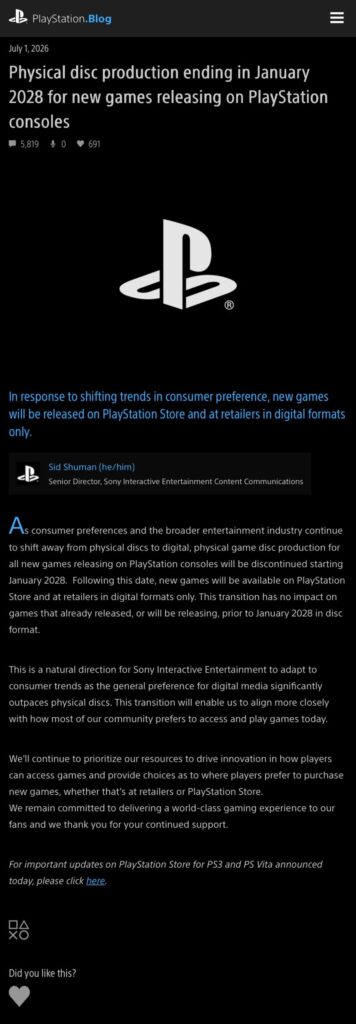
Then Sony dropped the bomb. Starting in January 2028, Sony will stop producing physical discs for new PlayStation games. New PlayStation releases after that point will be sold through the PlayStation Store and digital retailers instead. Sony says games already released on disc, or already scheduled for disc release before the cutoff, will not be affected. That still leaves the larger message sitting there in plain sight: the future PlayStation library will not need discs.
That is why this story hits harder than another old-store shutdown. Sony showed us the past and the future at the same time. The PS3 and Vita store closures remind us that digital storefronts have lifespans. The disc announcement tells us Sony wants the next era of PlayStation to depend on those storefronts anyway.
Anyone who cares about ownership should feel that in their stomach.
Sony Wants You to Hear “80% Digital” and Stop Thinking
Sony has the perfect number ready. Digital downloads accounted for about 80% of Sony’s full-game PlayStation software sales in fiscal 2025, according to Reuters. That sounds brutal. It makes discs look like a leftover habit, some dusty collector corner that the industry has outgrown. If you stop at that number, Sony’s move sounds obvious. Players chose digital, so Sony followed the market.
That version leaves out the part that matters. Sony’s broad digital number does not tell you what players choose when the same game launches with a real disc and a digital copy at the same time. It blends the whole software market together. That includes major AAA games, but it also includes games that never had a disc option, smaller digital-only titles, PS VR software, bundled software, cheap store clutter, and releases from publishers who could never afford a physical print run in the first place. That is not a clean vote against discs. That is a crowded ballot where half the candidates never showed up.
A small indie studio that launches digital-only did not prove players rejected physical. The studio may not have had the money for manufacturing, distribution, ratings, shipping, retail placement, returns, and unsold inventory. A tiny $3 download does not say anything useful about whether someone wants Spider-Man, Astro Bot, Resident Evil, Final Fantasy, or Assassin’s Creed on disc. Store slop inflates digital totals. Download-only releases inflate digital totals. Small publishers with no physical path inflate digital totals. Then Sony points at the pile and says players moved on.
That is not the full truth. That is the convenient truth.
The Apples-to-Apples Number Breaks the Story Wide Open
The cleaner question is simple: when PlayStation players can buy the same game physically or digitally, what do they choose?
The best public data we have tells a much different story than the 80% headline. The Game Business looked at PS5 games in Europe that were released both physically and digitally, excluding digital-only releases. In that cleaner comparison, 55% of PS5 games sold in Europe were digital in 2023. In 2024, that number rose to 64%. That means physical was still 45% in 2023 and 36% in 2024 when players had both options.
Read that again because it changes the whole argument. Sony’s broad number makes physical sound like a 20% leftover. The cleaner apples-to-apples number shows physical still taking more than a third of sales across comparable PS5 releases in Europe in 2024. One year earlier, physical was almost half.
That is not dead. That is not some tiny niche. That is millions of people choosing the version they can hold, lend, sell, trade, gift, collect, and preserve.
The genre split makes Sony’s broad number look even weaker as a consumer argument. The Game Business reported that single-player, story-driven, family, and prestige games can still lean hard toward physical. In the UK, 45% of Hogwarts Legacy sales were physical, 49% of Assassin’s Creed Mirage sales were physical, and 45% of Resident Evil 4 Remake sales were physical. Spider-Man 2 sold more through physical retailers than digital ones in the UK, with 54% physical, though that includes console bundles. Astro Bot was 55% physical in the UK and nearly 60% physical across Europe.
That is the part Sony would rather bury under the big digital headline. Shooters, sports games, live-service games, and PC-adjacent releases pull digital higher. Helldivers 2 was over 90% digital, according to The Game Business, and games like that shape the overall number. But family games, narrative games, collector-friendly games, and PlayStation-style prestige releases still have a strong physical audience.
Sony is using an investor number to make a consumer argument. Investors want margin, store control, and lower manufacturing costs. Players should ask a different question. If 36%, 45%, 54%, or nearly 60% of buyers still choose physical for certain games, why should Sony be allowed to act like the choice no longer matters?
Digital Did Not Win a Fair Fight
Digital is convenient. I buy digital games too. Most players do. Nobody wants to pretend that swapping discs feels modern when your entire library can sit on an SSD. Convenience has value, and digital delivers it.
The problem comes when companies pretend convenience explains the whole shift. The industry has pushed players toward digital for years. Retail shelf space shrank. Print runs got smaller. Some games skipped discs. Some discs shipped with huge downloads waiting. Some collector’s editions came with codes instead of games. The Xbox Series S launched without a drive. Sony sold a PS5 Digital Edition. Retailers made their game sections smaller. Console stores trained players to pre-order from the dashboard. Publishers gave digital deluxe editions early access, cosmetics, soundtracks, and bonus content that physical buyers often did not get. Then the same industry looked at the results and acted shocked that digital grew.
That is the loop. Make physical less convenient. Make digital the default. Watch physical sales fall. Tell everyone customers chose digital. Remove physical completely.
Players did choose digital in huge numbers. The choice was real for many people. But publishers and platform holders shaped the field. They closed lanes, moved incentives, shrank options, and counted every digital-only release as proof that discs lost.
Sony’s 80% number tells one story. The apples-to-apples numbers tell another. When the disc and the download sit next to each other, a large chunk of PlayStation players still pick the disc.
Sony knows that. Microsoft knows that. Nintendo knows that. Retailers know that. eBay knows that. Collectors know that. Parents who buy used games for their kids know that.
A Disc Is More Than Plastic
A disc is not perfect preservation. Modern physical games can be messy. Some need patches. Some depend on servers. Some include only part of the game. Some are glorified installers. Physical collectors need to be honest about that because pretending every disc is sacred makes the argument weaker.
A real physical release still gives players freedoms that digital does not.
You can sell it. You can lend it. You can trade it. You can give it to your kid. You can bring it to a friend’s house. You can find it years later in a used bin. You can buy it after a license expires. You can discover a game after the publisher has stopped promoting it. You can collect it without trusting one company account to stay alive forever.
Digital games feel owned because they sit in your library. You paid for them. You installed them. You may play them for years. But your access depends on accounts, stores, licenses, servers, platform policies, and the company’s long-term interest in supporting old purchases.
That does not mean digital purchases vanish tomorrow. It means the power sits somewhere else.
The PS3 and Vita store closures prove that storefronts age out. Sony says old purchases will remain available for the foreseeable future, and that is better than cutting people off. But “foreseeable future” is not ownership. It is a promise with no date attached. It asks you to trust that the same company closing the store will keep the download path open for as long as you care about the game.
Collectors have spent years warning about this, and people called them dramatic. Now Sony has closed one door on the past and dated the end of another door in the future.
Xbox May Be Building a Bridge, But It Still Leads to a License
Microsoft sits in a different position. Xbox has pushed digital harder than anyone through Game Pass, Play Anywhere, cloud saves, backward compatibility, and the disc-less Series S. Xbox deserves credit for keeping many older games playable on newer hardware. That matters. Microsoft treated backward compatibility like a feature instead of a museum project, and Xbox players benefited from that work.
The physical Xbox market still feels weak compared with PlayStation and Nintendo. Some releases skip Xbox discs. Some get smaller print runs. Some collectors avoid Xbox versions because they worry about incomplete discs or long-term preservation. Game Pass changed how many Xbox players think about buying games at all.
Now Microsoft may be testing a disc-to-digital feature. According to The Verge, Microsoft has tested a system that lets Xbox owners digitize Xbox One and Xbox Series X discs. The entitlement would tie to the specific disc and Microsoft account, and the digital access would move if the disc moves to another account or player. Original Xbox and Xbox 360 discs are reportedly not part of the test.
That idea sounds much better than leaving physical collectors stranded. If future Xbox hardware drops the disc drive, a disc-to-digital bridge could help players carry parts of their libraries forward. Microsoft may be trying to avoid the harshest version of Sony’s move.
But we should name the tradeoff. A disc-to-digital entitlement turns the disc into proof of access. That may help. It may feel generous compared with a hard cutoff. It may preserve some function for existing libraries. But it still moves ownership closer to the account system. The disc stops being the game and starts acting like a key. That is useful. It is not the same freedom as a disc that works without the platform holder revalidating your access.
Xbox may have the more thoughtful transition plan. Sony has the cleaner break. Both companies point in the same direction.
Nintendo May Be the One to Get Behind, With One Big Warning
Nintendo looks strange in this moment because the company gets so many things wrong and yet may be the last major console maker that still treats physical games as normal. Switch cartridges are small, durable, collectible, family-friendly, and easy to share. Nintendo’s audience still buys boxes. The Game Business reported that new Switch games are still around 80% physical in Europe, which shows Nintendo’s physical audience remains far stronger than PlayStation or Xbox.
That matters. Nintendo still has kids opening game cases on birthdays. It still has parents buying used games. It still has collectors hunting complete cartridges. It still has a platform where physical retail feels central instead of tolerated. So yes, Nintendo may be the platform to get behind if game ownership matters to you.
But there is a warning label big enough to cover the box. Switch 2 Game-Key Cards are not the same thing as full games on cartridge. A Game-Key Card gives you a physical object, but the card acts as a key for a download instead of carrying the full game data. That may still have resale value and some convenience, but it does not preserve the game in the same way a complete cartridge does. Nintendo is not pure. It is testing the same line, only from a better starting position.
Support Nintendo when the full game is on the cartridge. Support publishers that pay for the larger cart. Reward releases that work offline. Skip code-in-box when you can. Treat Game-Key Cards as a compromise, not a victory. Nintendo deserves support only when it protects the thing you care about. A box with a download key inside is digital wearing a costume.
Limited Run, Super Rare, and the Last Physical Lifeboats
This shift makes boutique physical publishers more important. Limited Run Games, Super Rare Games, iam8bit, Fangamer, Strictly Limited, and similar companies exist because digital-only games often need someone else to give them a physical life. They turn downloads into objects. They give collectors something to buy, archive, lend, display, and revisit.
That work matters more if Sony and Microsoft pull away from physical media. A small indie game may never reach a retail shelf. A weird horror game, puzzle platformer, narrative experiment, or retro-style release may never justify a mass-market disc. Boutique publishers can step in and give those games a second chance.
But the standard has to rise now. A boutique physical release only helps preservation if the game is actually there. A collector’s box with a download code does not save a game. A disc that still needs a huge server-side download does not solve much. A cartridge that only unlocks a download leaves future players depending on a storefront that may not exist.
The best boutique publishers need to fight for complete builds, final patches on disc or cart, offline play, clear labeling, and honest packaging. Collectors should reward the companies that do that work. They should call out the ones selling expensive shelf candy with weak preservation value.
Sony’s decision may push more boutique energy toward Nintendo, PC collector editions, retro reissues, soundtrack sets, art books, and specialty releases. PlayStation physical collecting may become more time-sensitive. If Sony stops new discs in 2028, every remaining PS4 and PS5 disc becomes part of a closed era. That sounds dramatic because the change is dramatic.
eBay and Used Games Are About to Matter More
The used game market is not just bargain hunting. It gives games a second life. eBay, GameStop, local retro stores, Facebook Marketplace, conventions, flea markets, and trading groups all depend on physical games moving from one person to another. A game can flop at launch and find an audience later. A kid can discover a PS3 game because someone sold it for ten bucks. A collector can rebuild a childhood library. A YouTuber can revive interest in something the publisher forgot. A parent can buy three used games instead of one new download.
Digital-only breaks that chain. There is no used digital copy. There is no resale value. There is no lending. There is no trade-in credit. There is no local shop discovery. There is no box that survives the account. The platform controls the price, the discount schedule, and the availability. That control helps companies. It hurts players.
If PlayStation discs end in 2028, the existing market changes overnight. PS3 games trapped on original hardware move higher on the priority list. Vita games get scarier. PS4 and PS5 complete editions become more important. Low-print games, delisted games, licensed games, final-patch discs, and titles with no modern ports may jump as collectors realize the PlayStation disc era now has an endpoint.
That does not mean panic-buy everything. It means buy with intent. Make a list. Start with games you care about, games that never got ported, games with expired licenses, games with strong single-player content, and games where the disc matters.
The late collectors will pay more. The early collectors will look smarter. The people who mocked physical media will end up searching eBay after the storefront closes.
Preservation Is the Culture Surviving the Business Model
Preservation does not mean refusing the future. It means games should survive the business model that sold them. Companies move on. Stores close. Licenses expire. Servers shut down. Payment systems age. Rights holders change. Music licenses disappear. Developers close. Publishers merge. Hardware breaks. Accounts get lost. Passwords vanish. A digital-only future asks players to trust that all of those things will work out.
Physical media does not solve every problem, but it gives players, collectors, libraries, archives, and families something to hold. It gives the game a chance to exist outside the storefront.
That matters most for the odd games. The forgotten games. The games that did not sell well enough to get a remaster. The games with licensed music. The games built for strange hardware. The PS3 games stuck on PS3. The Vita games nobody noticed until years later. The small games that never had marketing but deserved a shelf. A culture loses something when the only path to a game runs through an account screen.
Sony’s move exposes the bargain the industry wants players to accept. You get convenience. They get control. You get instant access. They get the end of resale. You get a cleaner dashboard. They get the power to decide what remains available. That may sound fine until the game you care about sits on the wrong side of a closed store.
The Recommendation
Nintendo is the best major console ecosystem to support right now if physical ownership matters to you, but only when the game is actually on the cartridge. Full carts deserve support. Game-Key Cards deserve caution. Code-in-box releases deserve rejection whenever a better option exists.
PlayStation collectors should move now with purpose. PS3 and Vita games need attention first because those stores have dated closures and many games remain trapped on old hardware. PS4 and PS5 physical libraries also matter more now because Sony has put an endpoint on new PlayStation discs. Buy the games you care about before the market fully absorbs what this means.
Xbox owners should watch Microsoft’s disc-to-digital plan, if it becomes real. It may help preserve access to parts of your library, and Microsoft deserves credit if it builds a consumer-friendly bridge. Still, do not confuse a digital entitlement with ownership. Useful access is not the same as a game you can hold, lend, resell, and preserve without permission.
Support Limited Run, Super Rare, iam8bit, Fangamer, Strictly Limited, and other boutique publishers when they do the hard version of physical publishing. Complete builds. Honest packaging. Offline play. Real media. Skip the expensive boxes that give you a code and call it preservation.
The larger recommendation is simpler. Stop letting companies use blended digital numbers to convince you that ownership is already dead. The apples-to-apples data shows a different picture. When players have a real choice, a huge number still choose physical. Sony knows that. The industry knows that. Now players need to know it too.
PlayStation just killed game discs. Maybe not the discs already on your shelf. Maybe not the games already scheduled before 2028. But Sony has marked the future of PlayStation physical media, and the PS3 and Vita store closures show what happens when the future becomes old enough for a company to stop caring.
The disc was never just plastic. It was your right to buy a game once and let it live somewhere other than a corporate account system.
That right is now on the clock.
Buy the Games and Gear Mentioned Here
As an Amazon Associate, AsWellToo may earn from qualifying purchases. These links help support the site, future reviews, and the projects we keep building here, at no extra cost to you.


