


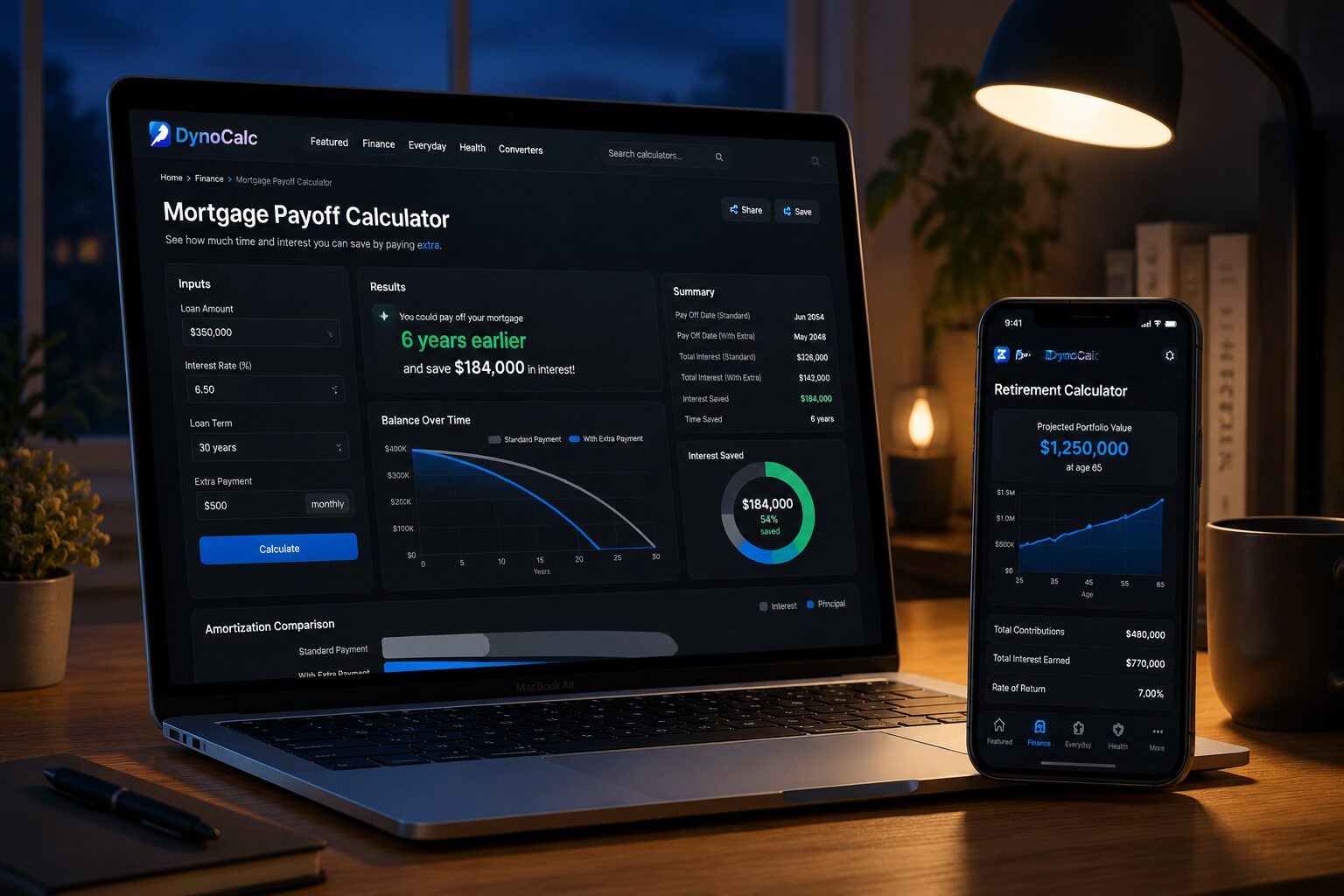
I did not start DynoCalc as a single idea or a planned product. It came together slowly over years, almost accidentally, through a long chain of small tools I kept building whenever I needed to solve something in my own life. Some of them were Excel spreadsheets with messy formulas I would reuse over and over. Some were simple web pages I spun up just to run a calculation without opening a full app. Some were lightweight tools I built quickly just to get an answer and move on.
Each one existed because I needed it in that moment. Not because I was trying to build a platform, but because something in my real life required clarity and I did not want to rely on whatever was already out there. It might have been tracking something financial, comparing options, converting measurements, or just testing a scenario I could not easily reason through in my head. The tool always came second. The problem always came first.
Over time, I started noticing a pattern in how often I was rebuilding the same kinds of solutions. I would solve something in Excel, then later rebuild a cleaner version as a web page, then sometimes rebuild it again as a lightweight app just because I wanted it faster or easier to access on my iPhone. It was never intentional product thinking, it was just repetition driven by necessity.
Eventually I reached a point where I realized I was not just making random tools anymore. I was repeatedly solving the same category of problem in slightly different ways, and each version was teaching me something about how people actually think when they are trying to make sense of numbers in real life.
That is when DynoCalc started to form, not as a single project, but as a collection of everything I had already built for myself over time.
Built From Necessity, Not Strategy
Most of the early tools came from very practical needs. Sometimes it was financial planning where I needed to quickly model different outcomes without relying on a heavy spreadsheet every time. Sometimes it was conversions or timing problems where I just wanted a fast answer without digging through multiple sites or apps. Sometimes it was about trying to lose a little weight and make sure I was on the right trajectory. Sometimes it was just curiosity where I wanted to see how changing one variable affected another in a controlled way.
The common thread was always the same. I needed clarity quickly, and whatever existed at the time either felt too heavy, too slow, or too cluttered for what I was trying to do. So I would build something small and direct that solved that exact problem and nothing more.
In hindsight, it was not really separate tools. It was the same mindset repeated in different forms, shaped by whatever situation I was in at the time.
From Spreadsheets to Web Pages to Small Apps
A lot of it started in Excel because that was the fastest way to model logic. I could throw together formulas, test outcomes, and refine them until they made sense. But spreadsheets are not always the most comfortable interface for real time thinking, so eventually I would rebuild those same ideas as simple web pages where I could interact with them more naturally.
Then came lightweight apps for things I used often enough that I wanted them to feel immediate. Nothing complex, just clean interfaces over the same logic I had already tested in spreadsheets. Each version was less about improving the idea and more about removing friction from how I used it.
That progression happened many times over the years without me really thinking about it as a system. It was just me solving the same types of problems in better ways as my tools improved.
There Was Something Bigger Here
The turning point for this project was not a single moment of inspiration. It was more gradual, like noticing a pattern that had been there the whole time. I realized I was not just building isolated tools anymore, I was repeatedly creating small systems for understanding real life decisions.
Money, timing, health metrics, conversions, planning scenarios, all of it started to feel like variations of the same underlying need. I was always trying to reduce uncertainty by breaking a situation into something I could test and understand before committing to it.
That is when I started to think there might actually be something here beyond personal use. Not just a collection of tools for myself, but something structured enough that other people could benefit from it too.
DynoCalc Was Born
Once I stepped back and looked at everything I had built over the years, it became clear that it was not random. It was a system of thinking tools that had evolved through necessity. I was not trying to build a product from scratch, I was assembling something that already existed in pieces.
DynoCalc became the way to unify all of that into one place. A single experience that combines financial thinking, health calculations, conversions, and everyday decision tools into something that reflects how people actually live, which is not in categories but in moments where they need clarity fast.
It is not about replacing deeper tools or complex systems. It is about handling the small and medium decisions that happen constantly and quietly shape how people move through their day.
Then $370,000 Changed Everything
The real turning point was not technical at all. It was personal. I ran into a number that completely shifted how I looked at everything I was building.
$370,000 for four years of college.
That number did not land like a statistic. It landed like a ton of bricks. It is one of those numbers that does not fully make sense until you sit with it long enough to understand what it actually means in real life terms. It is not abstract anymore when it is tied to your family, your future, and the decisions you are trying to make as a parent.
My daughter is an amazing person who deserves the chance to pursue her strengths and build her future without carrying the weight of that kind of cost before she even starts. That is what made it hit differently. It stopped being a general conversation about education costs and became something much more immediate and real.
That is when DynoCalc stopped being just something I was building out of habit and started becoming something I was actively using to think through reality itself.
What is DynoCalc Really?
At its core, DynoCalc is a reflection of all those years of small tools built out of necessity. It is not one idea, it is a collection of problems I kept solving in different ways until it became clear they all belonged together.
It is meant to give people a place to think clearly, test scenarios quickly, and understand the shape of decisions before they make them. Not in an abstract sense, but in the same practical way those early spreadsheets and small tools helped me when I needed answers fast.
DynoCalc offers you a chance to make mistakes in cyberspace with no judgement. Better to make mistakes in a tool than in the real world, right? That is the foundation it was built on, and the reason it exists at all.
Final Thought
DynoCalc did not start as a product idea. It started as necessity repeated over and over in different forms until it became something coherent.
It began with spreadsheets, became web tools, turned into lightweight apps, and eventually became a unified system because I realized I was solving the same kind of problem every time. What changed was not the idea, but the realization that other people might need the same kind of clarity I was building for myself all along.
That is what brought it together.
Support and Why It Matters
DynoCalc is and will always be free to use. That was never something I wanted to compromise on because the whole idea is to make everyday thinking and decision making more accessible, not less.
If you find it useful and it genuinely helps you think through decisions more clearly, the most meaningful thing you can do is simply share it with others who might benefit from it as well. That kind of organic support is what keeps a project like this alive.
For those who want to go a step further, there is also a Patreon available where you can support ongoing development of this project. Any support there goes directly into improving DynoCalc over time, expanding the tools, refining the experience, and keeping it fast, clean, and useful.
Over the next few years, part of that support will also go toward something deeply personal for me, which is helping cover my daughter’s college tuition. That is not the reason DynoCalc exists, but it is part of the reality behind why I am building it the way I am.
Either way, whether you use it, share it, or support it, I genuinely appreciate it. This is something I am building for the long term, and every bit of feedback, use, and support helps shape where it goes next.


