

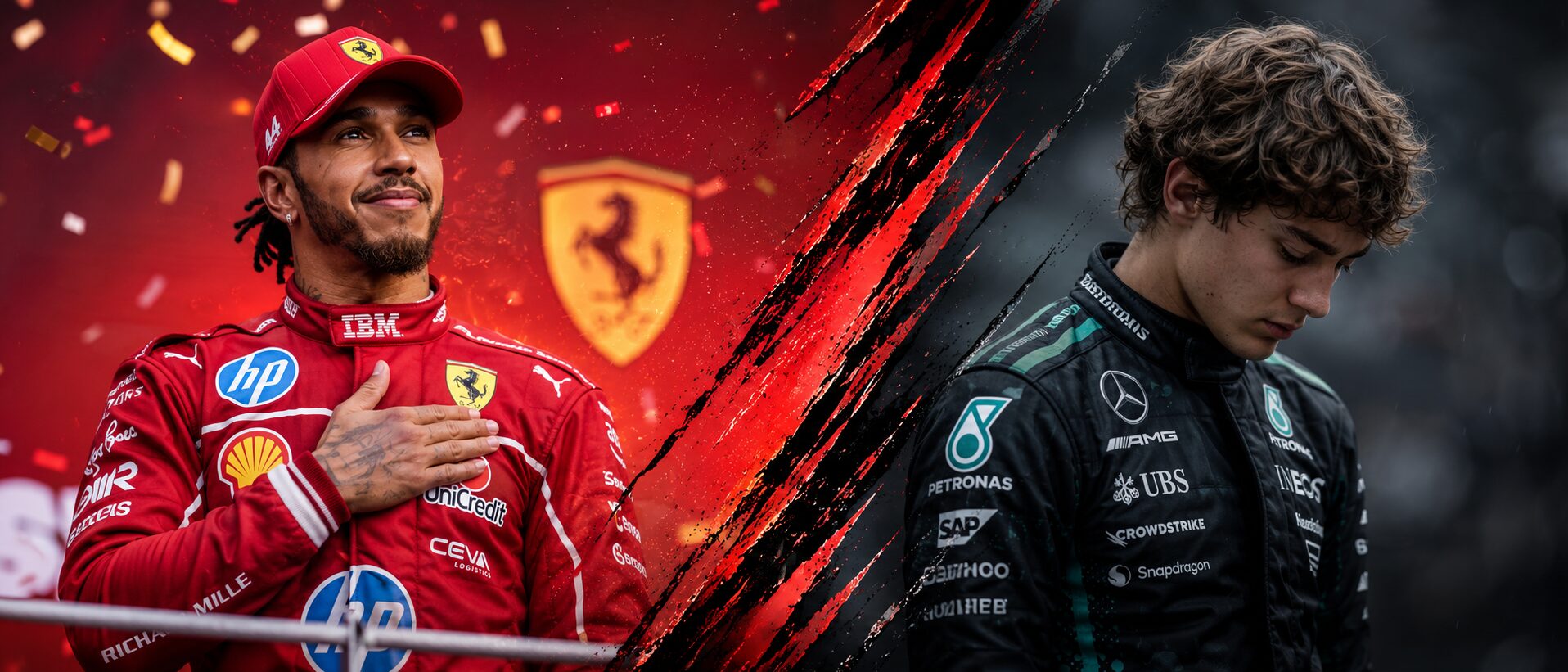
Barcelona did not feel like a normal Grand Prix weekend from the moment the paddock opened, because there was a strange kind of tension that had nothing to do with weather forecasts or tire allocations and everything to do with the sense that something was already in motion before the lights even went out, as if the entire grid was waiting for a shift they could not yet see but already felt tightening around them.
Into that atmosphere came two storylines that had been building all season in completely different ways, one belonging to Lewis Hamilton, a driver whose career has already defined multiple eras of Formula 1 and who had not stood on the top step of a Grand Prix since Belgium in 2024, and the other belonging to Kimi Antonelli, the breakout force of the season who arrived in Spain carrying five consecutive victories and the kind of momentum that starts to reshape how every rival approaches a race weekend before a single lap is completed.
Where We Are in the Season and Why Barcelona Hit So Hard
The season arriving in Barcelona had already settled into a familiar but dangerous shape, where early races were defined by experimentation, mid-season races began revealing true performance gaps, and the championship narrative started narrowing toward a handful of consistent frontrunners who were separating themselves from the rest of the grid through execution rather than raw speed alone.
Antonelli had emerged as the defining force of that middle phase, stacking wins in a way that turned him from a promising rookie story into the central reference point for the entire field, while Hamilton’s season had been defined more by fragments of competitiveness that never fully aligned across a weekend until Barcelona finally delivered a complete performance at a time when the season was beginning to harden into predictable patterns.
What made Barcelona so significant was not just the result itself but the timing within the calendar, because this was the point in the season where upgrades begin to stabilize, team philosophies stop shifting week to week, and every race begins to carry amplified championship weight, which meant that both Antonelli’s streak and Hamilton’s win arrived at a moment when there is no longer room for isolated storylines that do not affect the title picture.
Hamilton’s Win That Felt Less Like a Comeback and More Like a Reset of Expectations
Hamilton’s victory in Barcelona did not arrive with chaos or surprise, because instead it unfolded with a controlled inevitability that only became visible in the final stages when the gaps behind him stopped fluctuating and instead settled into a steady pressure that would normally trigger mistakes or tire degradation under stress, yet instead produced a level of composure that reminded the entire paddock why his name has survived every regulatory era the sport has thrown at him.
The significance of this win sits far deeper than a single race result because Hamilton has been operating in a long silence since his last Grand Prix win in 2024, a stretch that has included technical resets, team evolution, and a generational turnover that has seen younger drivers step into roles that once revolved around him, which is why Barcelona did not feel like nostalgia returning but rather like a correction to a timeline that had begun to feel slightly misaligned.
What defined the race was not dominance from start to finish but timing under pressure, because in the closing stint when the gap behind him stopped growing and began to stabilize at a threatening distance, Hamilton did not accelerate into panic or shift strategy into defense mode, but instead maintained rhythm in a way that turned the final laps into a controlled lock on the race rather than a survival exercise, which is exactly the kind of execution that defines champions when raw pace alone is not enough to separate the field.
Antonelli’s Five-Win Streak That Was Built on Control and Broken by Something Invisible
Antonelli entered Barcelona not as a surprise contender anymore but as the reference point for the entire grid, because five consecutive victories had already shifted him from emerging talent into the driver everyone else was now racing against rather than reacting to, and that level of consistency created a sense that his control over race weekends had become structural rather than situational.
The streak itself had not been built on chaos or opportunistic wins, because each victory had come through structured execution where tire management, qualifying positioning, and race pace aligned in a way that removed randomness from the equation, which is why Barcelona was expected to become a continuation of that pattern rather than an interruption to it.
However, what happened during the race was not a dramatic failure in the traditional sense but a progressive loss of capability that started with subtle inconsistencies in power delivery on corner exit and developed into irregular energy deployment on straights, which initially looked like minor telemetry variation but gradually revealed a deeper issue within the hybrid system that prevented the car from consistently recovering and deploying energy at full capacity.
The Engine Failure That Was Not an Explosion but a Slow Unraveling of Performance
The official explanation from the garage described a power unit issue, but the more precise interpretation within the paddock pointed toward a likely hybrid system imbalance triggered by sustained thermal stress, which created an energy recovery inefficiency that did not shut the car down but instead prevented it from operating at full potential, turning a leading race car into a machine that could no longer fully access its own speed.
What made this failure particularly devastating was not that it ended the race outright, but that it occurred while Antonelli was still leading, because the degradation did not remove him from contention in a single moment but instead slowly eroded his advantage until lap times that once controlled the race began to drift into parity and then into loss, which created a psychological shift on track that was visible even without broadcast commentary.
The most important detail was that Antonelli did not crash, did not spin, and did not suffer a sudden mechanical shutdown, because instead he experienced the far more modern form of Formula 1 failure where systems degrade under pressure while the car continues moving, which creates the illusion of continuity while the competitive edge quietly disappears lap by lap.
Kimi Antonelli’s History That Explains Why This Streak Meant More Than Just Wins
Antonelli’s rise into this level of competition has not been gradual in the traditional sense, because he entered Formula 1 carrying expectations that usually take years to accumulate, which meant that from his earliest races every performance was already being filtered through comparisons to established champions rather than judged in isolation as part of a normal rookie development curve.
The five-win streak that preceded Barcelona mattered because it represented the first time in his career where expectation and execution aligned without visible compromise, which is why the breakdown in Spain does not erase the achievement but instead reframes it as the beginning of a different phase where consistency under adversity becomes the real measure of his trajectory.
What Barcelona exposed is that dominance in Formula 1 is rarely about peak performance alone, but about how performance holds when systems fail around it, and that is now the question Antonelli will carry forward into the rest of the season.
Hamilton’s Return to Winning That Changes the Psychological Balance of the Grid
For Hamilton, this win does not function as a return to form narrative because his career has already exceeded the point where single results define identity, which means Barcelona instead operates as a recalibration of how the grid perceives him in real time, particularly in a season where younger drivers have begun to dominate headline narratives.
The gap since his last Grand Prix win in 2024 had slowly transformed into a background storyline that followed him into every weekend, not as a direct criticism but as an unspoken benchmark that shaped commentary and expectation, which is why this victory matters less as an endpoint and more as a disruption of that silence.
What makes Hamilton uniquely dangerous in this context is that he does not require streaks to remain relevant, because his competitive presence is built on timing, race reading, and execution under pressure, which means a single well-timed win can alter how teams approach him for multiple weekends afterward.
What Barcelona Actually Changes for the Championship Fight
Barcelona does not resolve the championship picture, but it removes the illusion that it was beginning to stabilize around a single dominant trajectory, because Antonelli’s streak and Hamilton’s return now sit in direct tension rather than separate narrative lanes, which forces the rest of the grid to adjust expectations in both directions at once.
Antonelli still carries the weight of a five-win run, which cannot be dismissed as coincidence or timing, yet Hamilton’s victory reintroduces variability at the front of the field that changes how aggressively teams will now plan strategy windows and tire usage in future races.
The most important shift is psychological rather than mathematical, because Barcelona has reminded every team that control in Formula 1 is always conditional, and that even the strongest streaks can be interrupted not by faster pace but by systems that fail under pressure at exactly the wrong moment.
The Race That Didn’t Decide Anything but Changed Everything Around It
Barcelona ultimately did not decide a championship or redefine the hierarchy in a permanent way, but it did something more subtle and often more impactful in a long season, which is that it removed certainty from the top of the field and replaced it with pressure that will now carry into every remaining race weekend.
Hamilton leaves Spain with renewed presence at the front of the sport, not because he has changed who he is, but because the grid has been reminded of what he can still do when a race compresses into its final stages, while Antonelli leaves with a streak broken but not diminished, only transformed into something that now has to be defended rather than simply extended.
Formula 1 rarely changes because of one race, but it almost always changes when a race proves that the story everyone was preparing for is not as stable as it seemed, and Barcelona delivered exactly that kind of interruption at exactly the point in the season where it matters most. This is why we love Formula 1.

